Slovenia
Country overview



Country overview
Select a country to explore its education data and publications.
Explore education indicators through the available country profiles.
Read the latest OECD country notes, reviews and analysis.

Select first some countries to compare, choose the charts you wish to display and customise them.
The gender difference in science performance in favour of girls is one of the largest among PISA-participating countries and economies. (-21 PISA Score points, rank 48/53 , 2025) Download Indicator
The change in science performance between 2022 and 2025 shows one of the largest decreases among PISA-participating countries and economies. (-16 PISA Score points, rank 20/27 , 2025) Download Indicator
In Slovenia, the average decennial rate of change in mean science performance over the period of participation in PISA was among the largest decreases across countries with available data. (-28 PISA Score, rank 44/47 , 2025) Download Indicator
The change in maths performance between 2022 and 2025 shows one of the largest decreases among PISA-participating countries and economies. (-25 PISA Score points, rank 44/46 , 2025) Download Indicator
The difference between girls and boys in reading performance is one of the largest in favor of girls among PISA-participating countries and economies. (-52 PISA Score points, rank 86/87 , 2025) Download Indicator
The average change in reading performance between 2022 and 2025 shows one of the strongest decreases among PISA-participating countries and economies. (-24 PISA Score points, rank 43/50 , 2025) Download Indicator
In Slovenia, the change in mathematics performance amongst the socio-economically advantaged students between 2022 and 2025 shows one of the strongest decreases among PISA-participating countries and economies. (-36 PISA Score points, rank 38/39 , 2025) Download Indicator
The change in science performance among socio-economically advantaged students between 2022 and 2025 shows one of the strongest decreases among PISA-participating countries and economies. (-25 PISA Score points, rank 28/30 , 2025) Download Indicator
The ratio of students to teaching staff in socio-economically disadvantaged schools is one of the smallest among PISA-participating countries and economies. (6 Students, rank 83/86 , 2025) Download Indicator
The ratio of students to teaching staff in socio-economically advantaged schools is one of the smallest among PISA-participating countries and economies. (9 Students, rank 82/86 , 2025) Download Indicator
The ratio of students to teaching staff in schools attended by 15-year-olds is comparatively low in Slovenia. (8 Students, rank 84/87 , 2025) Download Indicator
The difference in science performance associated with a one-unit increase in the index of teacher support is relatively small in Slovenia, before accounting for students' and schools' socio-economic profile. (-0.41 PISA Index, rank 79/81 , 2025) Download Indicator
In Slovenia, the gender difference in life satisfaction is relatively large in favor of boys compared to other countries and economies participating in PISA. (0.69 Life satisfaction index (0-10), rank 6/64 , 2025) Download Indicator
In Slovenia, the share of students who agreed or strongly agreed that they make friends easily was among the largest across countries with available data. (87.8 %, rank 8/88 , 2025) Download Indicator
In Slovenia, a relatively small number of students students reported that they are interested in and enjoy learning about science, compared to other OECD and partner countries/economies. (-0.41 PISA Index, rank 88/88 , 2025) Download Indicator
Compared to other OECD and partner countries/economies, students in Slovenia are not relatively curious, as measured by the PISA index of curiosity. (-0.26 PISA Index, rank 77/85 , 2025) Download Indicator
Slovenia had one of the lowest shares of students who agree or strongly agree they love learning new things in school. (51.8 %, rank 86/86 , 2025) Download Indicator
The index of perseverance among students in Slovenia is relatively low compared to other PISA-participating countries and economies. (-0.31 PISA Index, rank 80/81 , 2025) Download Indicator
Students in Slovenia show a low tendency to seek help compared to other PISA-participating countries and economies. (-0.23 PISA Index, rank 79/82 , 2025) Download Indicator
In Slovenia, the share of students who reported that they like to know how things work was among the smallest across countries with available data. (63.6 %, rank 80/86 , 2025) Download Indicator
The share of students who agreed or strongly agreed that they finish what they start was among the smallest in Slovenia compared with other countries with available data. (50.4 %, rank 82/87 , 2025) Download Indicator
In Slovenia, the share of students who agreed or strongly agreed that they apply additional effort when work becomes challenging was among the smallest across countries with available data. (51.4 %, rank 79/87 , 2025) Download Indicator
The share of students who agreed or strongly agreed that they finish tasks they started even when they become boring placed Slovenia among countries with the smallest shares. (41.6 %, rank 83/87 , 2025) Download Indicator
The gender difference in the index of cognitive adaptability (boys - girls) placed Slovenia among countries with the widest differences in favor of girls. (-0.16 PISA Index, rank 46/47 , 2025) Download Indicator
Slovenia recorded a relatively large difference in favor of public schools regarding the index of preparedness for digital learning. (-0.29 PISA Index, rank 48/49 , 2025) Download Indicator
Girls significantly outperform boys in environmental science. (-26 PISA Score points, rank 48/52 , 2025) Download Indicator
In Slovenia, the gender difference in the share of students interested, to some or a large extent, in contributing to protecting the environment in their future jobs (boys - girls) was among the largest in favor of girls across countries with available data. (-16.9 % points, rank 70/77 , 2025) Download Indicator
In Slovenia, the difference in the index of students' AI use for schoolwork between advantaged and disadvantaged schools was among the narrowest across countries with available data. (0.15 PISA Index, rank 54/63 , 2025) Download Indicator
In Slovenia, the difference between the shares of advantaged and disadvantaged students reporting that they assess the quality of information generated by AI chatbots in their school lessons sometimes or very often was among the narrowest across countries with available data. (5.2 %, rank 71/76 , 2025) Download Indicator
 to display other variables
to display other variables
to display other variables
to display other variables
to display other variables
to display other variables
to display other variables
to display other variables
to display other variables
to display other variables
to display other variables
to display other variables
to display other variables
to display other variables
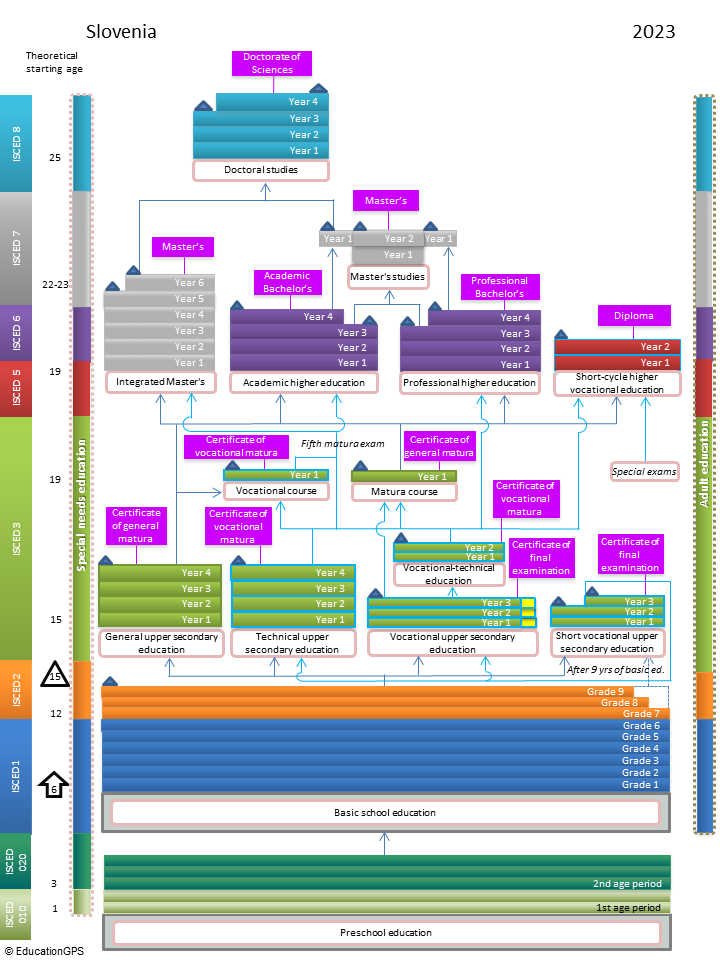
Click on the diagram to get a PDF version