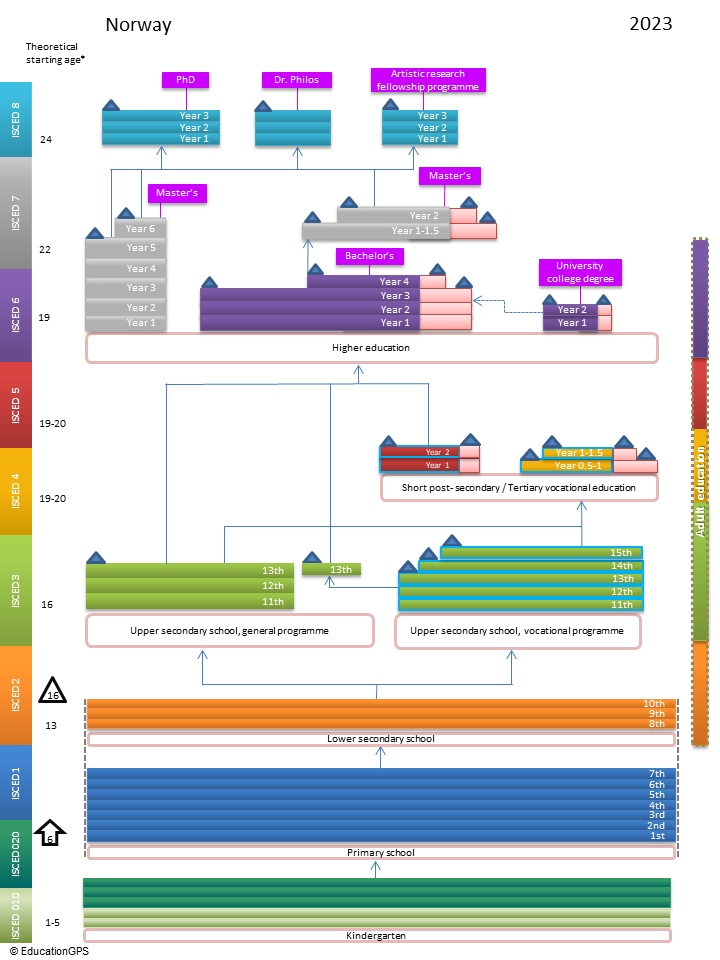
Norway
Country overview



Country overview
Select a country to explore its education data and publications.
Explore education indicators through the available country profiles.
Read the latest OECD country notes, reviews and analysis.

Select first some countries to compare, choose the charts you wish to display and customise them.
In Norway, the average decennial rate of change in mean science performance over the period of participation in PISA was among the largest decreases across countries with available data. (-29 PISA Score, rank 46/47 , 2025) Download Indicator
The change in maths performance between 2022 and 2025 shows one of the largest decreases among PISA-participating countries and economies. (-17 PISA Score points, rank 37/46 , 2025) Download Indicator
The average change in reading performance between 2022 and 2025 shows one of the strongest decreases among PISA-participating countries and economies. (-24 PISA Score points, rank 43/50 , 2025) Download Indicator
In Norway, the change in mathematics performance amongst the socio-economically disadvantaged students between 2022 and 2025 shows one of the strongest decreases among PISA-participating countries and economies. (-18 PISA Score points, rank 31/31 , 2025) Download Indicator
Students in Norway reported feeling relatively safer than students in other OECD and partner countries/economies. (0.44 PISA Index, rank 5/85 , 2025) Download Indicator
The change between 2015 and 2025 in the index of disciplinary climate in school science in Norway was among the largest decreases across countries with available data. (-0.06 PISA Index, rank 37/46 , 2025) Download Indicator
The share of students in schools whose principal reported that the use of cell phones is not allowed on the school premises is relatively high in Norway. (87.5 %, rank 9/88 , 2025) Download Indicator
In 2025, the index of sense of belonging was one of the highest among PISA-participating countries and economies. (0.39 PISA Index, rank 6/82 , 2025) Download Indicator
The gender difference in enjoyment of learning science (boys - girls) is relatively large in favor of boys in Norway compared to other OECD and partner countries/economies. (0.11 PISA Index, rank 6/64 , 2025) Download Indicator
Norway had one of the lowest shares of students who agree or strongly agree school has taught them things that could be useful in a job. (58.4 %, rank 83/87 , 2025) Download Indicator
Norway had one of the smallest shares of students who disagree that school has been a waste of time. (68.8 %, rank 81/87 , 2025) Download Indicator
The share of students who agreed or strongly agreed that they finish what they start was among the smallest in Norway compared with other countries with available data. (46.2 %, rank 86/87 , 2025) Download Indicator
In Norway, the share of students who agreed or strongly agreed that they apply additional effort when work becomes challenging was among the smallest across countries with available data. (48.6 %, rank 84/87 , 2025) Download Indicator
Students in Norway spent among the longest amounts of time on digital devices per day for learning activities at school across countries with available data. (3 Hours, rank 1/88 , 2025) Download Indicator
The change in science performance associated with students reporting that students get distracted by using digital resources in most or every school science lesson was among the smallest increases in Norway compared with other countries with available data, after accounting for student socio-economic status. (8 PISA Score points, rank 3/61 , 2025) Download Indicator
Norway ranked among the countries with the smallest share of students with environmental sense-of-purpose (among students who reported that looking after the global environment is important to them). (68 %, rank 83/88 , 2025) Download Indicator
Norway has one of the smallest shares of students believing in their own capacity to generate environmental change. (-0.11 PISA Index, rank 78/87 , 2025) Download Indicator
Students in Norway show one of the smallest indices of belief in collective environmental efficacy. (-0.17 PISA Index, rank 81/87 , 2025) Download Indicator
Norway has one of the smallest shares of students participating in environment-related activities. (-0.24 PISA Index, rank 84/88 , 2025) Download Indicator
The percentage of students reporting their participation to at least one environmental-related activity is relatively low in Norway. (63.5 %, rank 83/88 , 2025) Download Indicator
In Norway, the difference in the index of students' AI use for schoolwork between advantaged and disadvantaged schools was among the narrowest across countries with available data. (0.15 PISA Index, rank 54/63 , 2025) Download Indicator
 to display other variables
to display other variables
to display other variables
to display other variables
to display other variables
to display other variables
to display other variables
to display other variables
to display other variables
to display other variables
to display other variables
to display other variables
to display other variables
to display other variables
to display other variables
to display other variables
to display other variables
to display other variables
to display other variables
to display other variables
to display other variables
to display other variables
to display other variables
to display other variables
to display other variables
to display other variables
to display other variables
to display other variables
to display other variables
Click on the diagram to get a PDF version