In Greece, the share of adults with tertiary attainment reaches 34.9% (OECD average : 42.7%), while the share of adults with upper secondary or post-secondary non-tertiary attainment stands at 46.8% (OECD average : 39.9%) and 18.2% of 25-64 year-olds reached below upper secondary education (OECD average : 17.9%).
Government expenditure on educational institutions, before transfers, on primary to tertiary education equalled 2.9% of GDP in 2023 (OECD average : 4%), while private expenditure equalled 0.5% (OECD average : 0.6%).
In 2023, Greece allocated an average of 6.1% of total government expenditure to education from primary to tertiary levels (OECD average : 9.8%), equivalent to 3% of GDP (OECD average : 4.2%).
Total expenditure on educational institutions per full-time equivalent student equalled 5890 equivalent USD for tertiary education in Greece (OECD average : 22402 equivalent USD), while it added up to 9121 equivalent USD for primary education (OECD average : 13552 equivalent USD).
The unemployment rate among tertiary-educated young adults stands at 10.7% in 2025 (OECD average : 5%), while it is equal to 22.7% for 25-34 year-olds without an upper secondary education (OECD average : 13.9%).
Some 18.6% of all 18-24 year-olds were not in employment, education or training (NEET) in 2025 (OECD average : 14.1%), while 26.6% of 25-29 year-olds were NEET (OECD average : 16.3%).
On-site work varies with the level of education, while 14.3% of tertiary-educated workers sometimes or usually work from home in Greece (OECD average : 42.5%), 3.4% of workers with upper secondary or post-secondary non-tertiary attainment did so (OECD average : 17.7%).
In Greece, annual typical teaching hours were 645 hours in primary education (OECD average : 770 hours) and 600 hours in lower secondary education (OECD average : 710 hours).
Women represent 98.3% of pre-primary teaching staff in Greece (OECD average : 95.9%) and 70.1% in lower secondary education (OECD average : 68.2%).
Select first some countries to compare, choose the charts you wish to display and customise them.
Highlights
Data table
Charts by topic
Policies
Publications
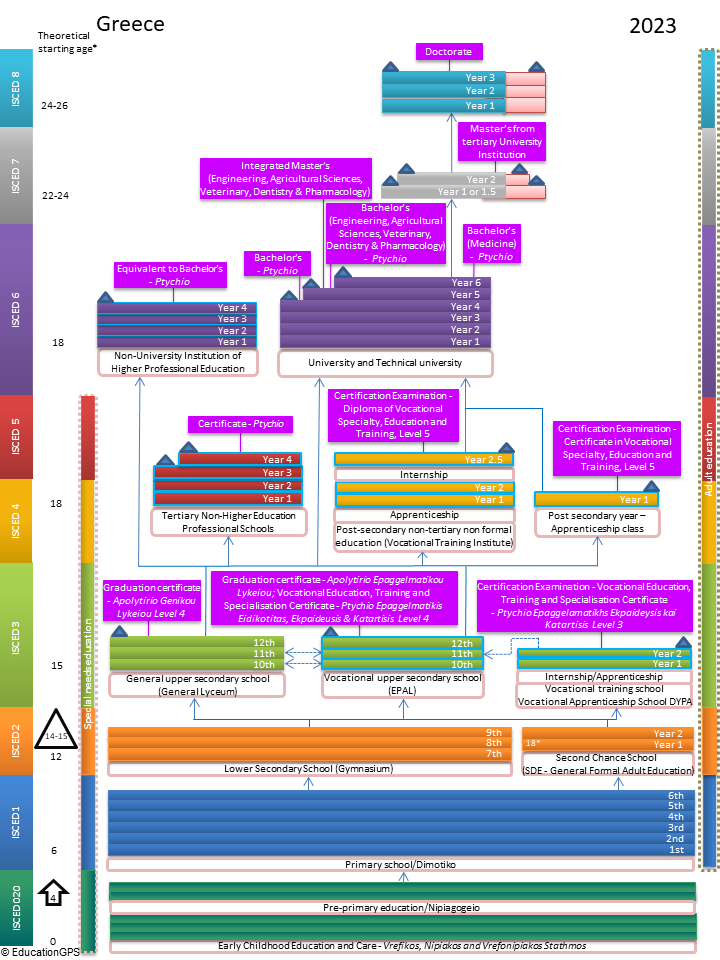
Diagram of education system
Compare with OECD countries
Australia
Austria
Belgium
Flemish Region (Belgium)
Belgium (French)
Belgium (excl. Flemish)
Canada
Alberta (Canada)
New Brunswick (Canada)
Quebec (Canada)
Canadian provinces
Chile
Colombia
Costa Rica
Czechia
Denmark
Estonia
Finland
France
Germany
Hungary
Iceland
Ireland
Israel
Italy
Japan
Korea
Latvia
Lithuania
Luxembourg
Mexico
Netherlands
New Zealand
Norway
Poland
Portugal
Slovak Republic
Slovenia
Spain
Sweden
Switzerland
Türkiye
United Kingdom
England (UK)
Northern Ireland (UK)
Scotland (UK)
United States
OECD average
OECD total
And non-OECD countries
G20 average
TALIS average
TALIS avg. primary education
TALIS avg. upper secondary education
Albania
Algeria
Argentina
Armenia
Azerbaijan
Bahrain
Buenos Aires (Argentina)
Bosnia and Herzegovina
Brazil
Brunei Darussalam
Bulgaria
Cambodia
China
B-S-J-Z (China)
Hong Kong (China)
Macao (China)
Shanghai (China)
Chinese Taipei
Croatia
Dominican Republic
Ecuador
Egypt
El Salvador
Georgia
Guatemala
India
Indonesia
Jamaica
Jordan
Kazakhstan
Kenya
Kyrgyzstan
Kosovo
Kurdistan Region (Iraq)
Lebanon
North Macedonia
Malaysia
Malta
Mauritius
Moldova
Mongolia
Montenegro
Morocco
Palestinian Authority
Panama
Paraguay
Peru
Philippines
Qatar
Romania
Rwanda
Saudi Arabia
Serbia
Singapore
South Africa
Tajikistan
Dushanbe (Tajikistan)
Thailand
Trinidad and Tobago
Tunisia
United Arab Emirates
Abu Dhabi (UAE)
Ukraine
Uruguay
Uzbekistan
Viet Nam
Zambia
The following list displays indicators for which your selected country shows the highest and lowest values among countries.
The list can be sorted by level of education or by age group. All rankings are calculated including available data from OECD
and partner countries.
Find out more about the methodology here.
Show indicators for which your country ranks among the top or bottom:
Sort by:
18-24 years
The percentage of 18-24 year-old men neither employed nor in education or training is one of the highest among OECD countries and partner economies with available data.
(18.7 %, rank 5/38
, 2025) Download Indicator
Under 25 years
In Greece, the average age of new entrants in bachelor's programmes is one of the lowest among OECD and partner countries with available data.
(19.8 Years, rank 35/39
, 2024) Download Indicator
In Greece, the average age of post-secondary non-tertiary graduates from vocational programmes is one of the lowest among OECD and partner countries with available data
(27 Years, rank 20/24
, 2024) Download Indicator
The average age of new entrants in tertiary education in Greece is comparatively young.
(19.8 Years, rank 29/32
, 2024) Download Indicator
The average age of lower secondary students enrolled in vocational programmes in Greece is one of the lowest compared to other countries with available data.
(16.6 %, rank 16/20
, 2024) Download Indicator
The average age of post-secondary non-tertiary students enrolled in vocational programmes in Greece is among the lowest.
(25.7 %, rank 25/27
, 2024) Download Indicator
25-29 years
The share of 25-29 year-olds neither in employment nor in education and training with tertiary education in Greece is relatively high.
(19.5 %, rank 3/38
, 2025) Download Indicator
The share of youth neither employed nor in education or training among 25-29 year-olds in Greece is one of the highest among OECD and partner countries with available data.
(26.6 %, rank 3/38
, 2025) Download Indicator
25-34 years
The unemployment rate among 25-34 year-olds with below upper secondary education is comparatively high across surveyed countries.
(22.7 %, rank 4/38
, 2025) Download Indicator
The unemployment rate among 25-34 year-olds with upper secondary or post-secondary non-tertiary education is comparatively high across surveyed countries.
(12.4 %, rank 3/40
, 2025) Download Indicator
The unemployment rate among 25-34 year-olds with tertiary education is comparatively high across surveyed countries.
(10.7 %, rank 2/40
, 2025) Download Indicator
The employment rate among 25-34 year-old men with tertiary education is relatively low in Greece compared to other participating countries.
(81.7 %, rank 39/40
, 2025) Download Indicator
The employment rate among 25-34 year-olds with upper secondary or post-secondary non-tertiary education is relatively low in Greece compared to other participating countries.
(69.7 %, rank 36/40
, 2025) Download Indicator
The employment rate among 25-34 year-old women with upper secondary or post-secondary non-tertiary education is relatively low in Greece compared to other participating countries.
(57.9 %, rank 37/40
, 2025) Download Indicator
The unemployment rate among 25-34 year-old men with tertiary education is relatively high in Greece compared to other participating countries.
(11.1 %, rank 2/38
, 2025) Download Indicator
The unemployment rate among 25-34 year-old women with tertiary education is relatively high in Greece compared to other participating countries.
(10.4 %, rank 4/38
, 2025) Download Indicator
The proportion of 25-34 year-olds who have attained a general degree at the upper secondary or post-secondary non-tertiary level is one of the highest among OECD and partner countries with available data.
(29.2 %, rank 5/37
, 2025) Download Indicator
The employment rate among 25-34 year-olds with a vocational upper secondary or post-secondary non-tertiary education is relatively low compared to other OECD and partner countries.
(76.3 %, rank 29/32
, 2025) Download Indicator
Compared to other countries with available data, the employment rate of 25-34 year-olds with a master's or equivalent tertiary education degree is relatively low in Greece.
(84.3 %, rank 32/36
, 2025) Download Indicator
In Greece, the employment rate among 25-34 year-old women with vocational upper secondary or post-secondary non-tertiary education is comparatively low.
(64.9 %, rank 30/32
, 2025) Download Indicator
Compared to other countries with available data, the employment rate of 25-34 year-old women with general upper secondary or post-secondary non-tertiary education is relatively low in Greece.
(53.1 %, rank 33/35
, 2025) Download Indicator
The salaries of 25-34 year-old general lower-secondary teachers relative to earnings for full-time, full-year similarly educated workers with tertiary education are low in Greece.
(0.67 Ratio, rank 25/26
, 2025) Download Indicator
The average actual salaries of 25-34 year-old lower-secondary teachers in Greece are among the lowest across countries with available data.
(22960 USD Equivalent, rank 27/27
, 2025) Download Indicator
Under 30 years
The share of teachers younger than 30 in secondary schools is among the smallest compared to other OECD and partner countries with available data.
(1.5 %, rank 40/40
, 2024) Download Indicator
The percentage of lower secondary teachers younger than 30 is especially low.
(1.4 %, rank 39/39
, 2024) Download Indicator
The percentage of upper secondary teachers younger than 30 is especially low.
(1.6 %, rank 42/42
, 2024) Download Indicator
In Greece, the share of bachelor's, master's and doctoral level teachers younger than 30 is relatively low, compared to other countries with data available.
(1.2 %, rank 34/36
, 2024) Download Indicator
In Greece, the share of tertiary teachers younger than 30 is relatively low, compared to other countries with data available.
(1.2 %, rank 34/36
, 2024) Download Indicator
In upper secondary general education, the percentage of teachers under 30 in Greece is one of the lowest among OECD and partner countries with available data.
(1 %, rank 36/36
, 2024) Download Indicator
The share of teachers under 30 in upper secondary vocational education is especially small in Greece.
(2.4 %, rank 31/32
, 2024) Download Indicator
30-39 years
The share of teachers aged between 30 and 39 in secondary schools is especially small.
(12.4 %, rank 38/40
, 2024) Download Indicator
30-49 years
The percentage of lower secondary teachers aged between 30 and 49 is especially low.
(40.8 %, rank 35/39
, 2024) Download Indicator
The percentage of upper secondary teachers aged between 30 and 49 is especially low.
(40.1 %, rank 40/42
, 2024) Download Indicator
In Greece, the share of bachelor's, master's and doctoral level teachers aged between 30 and 49 is relatively low, compared to other countries with data available.
(43.4 %, rank 34/36
, 2024) Download Indicator
In Greece, the share of tertiary teachers aged between 30 and 49 is relatively low, compared to other countries with data available.
(43.4 %, rank 35/36
, 2024) Download Indicator
In Greece, the percentage of upper secondary general education teachers aged between 30 and 49 is relatively low, compared to the other countries with available data.
(35.8 %, rank 35/36
, 2024) Download Indicator
Under 35 years
In Greece, the percentage of first-time master's graduates younger than 35 is relatively low.
(63.7 %, rank 28/31
, 2024) Download Indicator
35-44 years
The employment rate among 35-44 year-olds with a vocational upper secondary or post-secondary non-tertiary education is relatively low compared to other OECD and partner countries.
(78.9 %, rank 30/32
, 2025) Download Indicator
The salaries of 35-44 year-old general lower-secondary teachers relative to earnings for full-time, full-year similarly educated workers with tertiary education are low in Greece.
(0.63 Ratio, rank 25/26
, 2025) Download Indicator
In Greece, the average actual salaries of 35-44 year-old lower-secondary teachers is one of the lowest among OECD and partner countries.
(28665 USD Equivalent, rank 27/27
, 2025) Download Indicator
The average actual salaries of 35-44 year-old lower secondary school heads is one of the lowest in Greece.
(47339 USD Equivalent, rank 24/24
, 2025) Download Indicator
45-54 years
In Greece, the average actual salaries of 45-54 year-old lower-secondary teachers is one of the lowest among OECD and partner countries.
(36452 USD Equivalent, rank 27/27
, 2025) Download Indicator
The average actual salaries of 45-54 year-old lower secondary school heads is one of the lowest in Greece.
(52112 USD Equivalent, rank 24/24
, 2025) Download Indicator
50 years and over
Females aged 50 or more represent a small proportion of teachers in primary education in Greece.
(65.4 %, rank 41/42
, 2024) Download Indicator
The share of teachers aged 50 or more in post secondary non-tertiary education is relatively small in Greece, compared to the other countries with available data.
(36.4 %, rank 20/22
, 2024) Download Indicator
55-64 years
The salaries of 55-64 year-old general lower-secondary teachers relative to earnings for full-time, full-year similarly educated workers with tertiary education are low in Greece.
(0.67 Ratio, rank 23/26
, 2025) Download Indicator
In Greece, the average actual salaries of 55-64 year-old lower-secondary teachers is one of the lowest among OECD and partner countries.
(41146 USD Equivalent, rank 26/27
, 2025) Download Indicator
The average actual salaries of 55-64 year-old lower secondary school heads is one of the lowest in Greece.
(55541 USD Equivalent, rank 23/24
, 2025) Download Indicator
25-64 years
The employment rate among 25-64 year-old men with tertiary education is comparatively low across participating countries.
(86 %, rank 40/41
, 2025) Download Indicator
The unemployment rate among 25-64 year-olds with tertiary education is comparatively high across surveyed countries.
(6.3 %, rank 4/40
, 2025) Download Indicator
Greece has one of the smallest shares of 25-64 year-old men whose highest education level is a short-cycle tertiary education degree.
(0.3 %, rank 32/35
, 2025) Download Indicator
The unemployment rate among 25-64 year-olds with a vocational upper secondary or post-secondary non-tertiary education is high compared to other OECD and partner countries.
(9.6 %, rank 2/33
, 2025) Download Indicator
The unemployment rate among 25-64 year-olds with a general upper secondary or post-secondary non-tertiary education is high compared to other OECD and partner countries.
(8.6 %, rank 5/35
, 2025) Download Indicator
In Greece, the share of employed 25-64 year-old women with general upper secondary or post-secondary non-tertiary education is relatively low, compared to other OECD and partner countries with available data.
(56.7 %, rank 34/36
, 2025) Download Indicator
In Greece, the share of employed 25-64 year-old women with vocational upper secondary or post-secondary non-tertiary education is relatively low, compared to other OECD and partner countries with available data.
(65.8 %, rank 28/32
, 2025) Download Indicator
Among employed adults aged 25-64 with below upper secondary attainment, the share who sometimes or usually work from home in Greece was among the smallest across countries with available data.
(2.1 %, rank 26/29
, 2023) Download Indicator
The share of employed adults aged 25-64 with upper secondary or post-secondary non-tertiary attainment who sometimes or usually work from home was among the lowest in Greece compared with other countries with available data.
(3.4 %, rank 30/32
, 2023) Download Indicator
In Greece, the share of employed adults aged 25-64 with tertiary attainment who sometimes or usually work from home was among the smallest across countries with available data.
(14.3 %, rank 29/32
, 2023) Download Indicator
In Greece, the share of adults aged 25-64 with upper secondary or post-secondary non-tertiary attainment who kept worrying about work when not working some or most of the time was among the largest across countries with available data.
(42.2 %, rank 5/26
, 2024) Download Indicator
The ratio of pre-primary teachers' salaries to earnings of full-time, full-year workers with tertiary education is one of the lowest among OECD and partner countries with available data.
(0.69 Ratio, rank 13/17
, 2025) Download Indicator
The ratio of primary teachers' salaries to earnings of full-time, full-year workers with tertiary education is one of the lowest among OECD and partner countries with available data.
(0.69 Ratio, rank 14/18
, 2025) Download Indicator
In Greece, average actual salaries for pre-primary teachers aged 25-64 rank among the lowest across OECD and partner countries with available data.
(33607 USD Equivalent, rank 28/30
, 2025) Download Indicator
In Greece, average actual salaries for primary teachers aged 25-64 rank among the lowest across OECD and partner countries with available data.
(33607 USD Equivalent, rank 33/34
, 2025) Download Indicator
In Greece, average actual salaries for lower secondary teachers aged 25-64 rank among the lowest across OECD and partner countries with available data.
(36478 USD Equivalent, rank 33/34
, 2025) Download Indicator
In Greece, average actual salaries for upper secondary teachers aged 25-64 rank among the lowest across OECD and partner countries with available data.
(36478 USD Equivalent, rank 33/34
, 2025) Download Indicator
The average actual salary of 25-64 year-old lower secondary female teachers is one of the lowest among OECD and partner countries with available data.
(36072 USD Equivalent, rank 27/27
, 2025) Download Indicator
The average actual salary of 25-64 year-old lower secondary male teachers is one of the lowest among OECD and partner countries with available data.
(37326 USD Equivalent, rank 27/27
, 2025) Download Indicator
In Greece, actual salaries of pre-primary school heads aged 25-64 relative to earnings of full-time, full-year tertiary-educated workers are low.
(0.92 Ratio, rank 12/15
, 2025) Download Indicator
In Greece, actual salaries of primary school heads aged 25-64 relative to earnings of full-time, full-year tertiary-educated workers are low.
(0.92 Ratio, rank 14/16
, 2025) Download Indicator
In Greece, actual salaries of lower secondary school heads aged 25-64 relative to earnings of full-time, full-year tertiary-educated workers are low.
(0.98 Ratio, rank 12/16
, 2025) Download Indicator
In Greece, actual salaries of upper secondary school heads aged 25-64 relative to earnings of full-time, full-year tertiary-educated workers are low.
(0.98 Ratio, rank 15/17
, 2025) Download Indicator
In Greece, the average actual salaries of 25-64 year-old pre-primary school heads is one of the lowest among OECD and partner countries.
(47620 USD Equivalent, rank 22/23
, 2025) Download Indicator
In Greece, the average actual salaries of 25-64 year-old primary school heads is one of the lowest among OECD and partner countries.
(47620 USD Equivalent, rank 29/30
, 2025) Download Indicator
In Greece, the average actual salaries of 25-64 year-old lower secondary school heads is one of the lowest among OECD and partner countries.
(54242 USD Equivalent, rank 28/30
, 2025) Download Indicator
In Greece, the average actual salaries of 25-64 year-old upper-secondary school heads is one of the lowest among OECD and partner countries.
(54242 USD Equivalent, rank 28/30
, 2025) Download Indicator
The average actual salaries of lower secondary men school heads aged 25 to 64 is one of the lowest in Greece.
(54579 USD Equivalent, rank 24/25
, 2025) Download Indicator
The average actual salaries of lower secondary women school heads aged 25 to 64 is one of the lowest in Greece.
(54363 USD Equivalent, rank 24/25
, 2025) Download Indicator
All ages
Greece has a small share of international students among tertiary graduates compared to other OECD countries and partner economies.
(1.9 %, rank 28/30
, 2024) Download Indicator
The percentage of tertiary graduates in the field of information and communication technologies is one of the lowest among OECD and partner countries with available data.
(3.8 %, rank 33/37
, 2024) Download Indicator
The percentage of international students entering tertiary education in Greece is relatively low.
(2.7 %, rank 29/33
, 2024) Download Indicator
The share of international students entering doctoral or equivalent programmes in Greece is relatively small.
(1.7 %, rank 37/37
, 2024) Download Indicator
The percentage of students enrolled in the field of business, administration and law among all international or foreign tertiary students in Greece is relatively low.
(13.3 %, rank 34/38
, 2024) Download Indicator
In Greece, the percentage of female students enrolled in upper secondary vocational programmes is one of the lowest among OECD and partner countries.
(37.6 %, rank 37/41
, 2024) Download Indicator
In Greece, the share of international and foreign students among all students in the field of arts and humanities is one of the smallest among OECD and partner countries with available data.
(2.8 %, rank 35/39
, 2024) Download Indicator
In Greece, the share of international and foreign students among all students in the field of social sciences, journalism and information is one of the smallest among OECD and partner countries with available data.
(2.8 %, rank 35/39
, 2024) Download Indicator
In Greece, the share of international and foreign students among all students in the field of business, administration and law is one of the smallest among OECD and partner countries with available data.
(1.8 %, rank 35/38
, 2024) Download Indicator
In Greece, the share of international or foreign students enrolled in doctoral or equivalent programmes is one of the smallest among OECD and partner countries with available data.
(1.5 %, rank 41/41
, 2024) Download Indicator
The share of doctoral graduates in the field of social sciences, journalism and information in Greece is relatively small.
(6 %, rank 35/38
, 2024) Download Indicator
In Greece, international or foreign students from Latin America and the Caribbean are least represented among all international or foreign students, compared to other OECD and partner countries with available data.
(0.4 %, rank 35/37
, 2024) Download Indicator
In Greece, the percentage of post-secondary non-tertiary vocational graduates in the field of business, aministration and law is relatively low.
(7.7 %, rank 17/21
, 2024) Download Indicator
In Greece, the proportion of international students among first-time bachelor's graduates is relatively low.
(1.9 %, rank 28/30
, 2024) Download Indicator
In Greece, the proportion of international students among first-time master's graduates is relatively low.
(0.6 %, rank 30/30
, 2024) Download Indicator
In Greece, the proportion of international students among first-time doctorate graduates is relatively low.
(0.9 %, rank 29/29
, 2024) Download Indicator
The proportion of international students among the new entrants in master's programmes in Greece is relatively low compared to other OECD and partner countries.
(0.6 %, rank 37/38
, 2024) Download Indicator
In Greece, the proportion of international or foreign students enrolled in master's programmes is one of the smallest among OECD and partner countries with available data.
(0.6 %, rank 41/42
, 2024) Download Indicator
In Greece, the share of international or foreign students enrolled in doctoral or equivalent programmes among men is relatively low compared to other OECD and partner countries.
(1.7 %, rank 40/40
, 2024) Download Indicator
In Greece, the share of international or foreign students enrolled in doctoral or equivalent programmes among women is relatively low compared to other OECD and partner countries.
(1.3 %, rank 40/40
, 2024) Download Indicator
In Greece, the share of international or foreign students enrolled in master's programmes among men is relatively low compared to other OECD and partner countries.
(0.8 %, rank 40/41
, 2024) Download Indicator
In Greece, the share of international or foreign students enrolled in master's programmes among women is relatively low compared to other OECD and partner countries.
(0.5 %, rank 40/41
, 2024) Download Indicator
In Greece, the share of international or foreign students enrolled in tertiary education among men is relatively low compared to other OECD and partner countries.
(2.5 %, rank 37/41
, 2024) Download Indicator
In Greece, the share of international or foreign students enrolled in tertiary education among women is relatively low compared to other OECD and partner countries.
(2.7 %, rank 37/41
, 2024) Download Indicator
The share of female students enrolled in lower secondary vocational programmes is one of the lowest among OECD countries and partner economies with available data.
(33 %, rank 19/20
, 2024) Download Indicator
The number of pupils per teacher in pre-primary schools is one of the lowest among OECD and partner countries with available data.
(7.7 Ratio, rank 37/38
, 2024) Download Indicator
The number of students per teacher in primary schools is one of the lowest among OECD countries and partner countries with available data.
(7.4 Ratio, rank 43/43
, 2024) Download Indicator
The ratio of students to teaching staff at the lower secondary level is especially low.
(8.4 Ratio, rank 37/39
, 2024) Download Indicator
The number of students per teacher in secondary schools is one of the smallest among OECD and partner countries with available data.
(8.9 Ratio, rank 37/39
, 2024) Download Indicator
After 15 years of experience, a lower secondary teacher with minimum qualification can expect to have one of the lowest salaries among OECD and partner countries with available data.
(32883 USD Equivalent, rank 38/42
, 2025) Download Indicator
After 15 years of experience, an upper secondary teacher with minimum qualification can expect to have one of the lowest salaries among OECD and partner countries with available data.
(32883 USD Equivalent, rank 38/42
, 2025) Download Indicator
After 15 years of experience, a pre-primary teacher with minimum qualification can expect to have one of the lowest salaries among OECD and partner countries with available data.
(32883 USD Equivalent, rank 31/35
, 2025) Download Indicator
After 15 years of experience, a primary teacher with minimum qualification can expect to have one of the lowest salaries among OECD and partner countries with available data.
(32883 USD Equivalent, rank 38/42
, 2025) Download Indicator
Compared to 2015, the change in statutory salaries for primary education teachers with 15 years of experience and the most prevalent qualifications in Greece was relatively small.
(92 Index, rank 30/33
, 2025) Download Indicator
Compared to 2015, the change in statutory salaries for lower secondary education teachers with 15 years of experience and the most prevalent qualifications in Greece was relatively small.
(92 Index, rank 30/33
, 2025) Download Indicator
Compared to 2015, the change in statutory salaries for upper secondary education teachers with 15 years of experience and the most prevalent qualifications in Greece was relatively small.
(92 Index, rank 30/33
, 2025) Download Indicator
In Greece, pre-primary public schools have among the fewest instruction days per school year across OECD and partner countries with available data.
(172 Days, rank 35/36
, 2025) Download Indicator
In Greece, primary public schools have among the fewest instruction days per school year across OECD and partner countries with available data.
(172 Days, rank 38/42
, 2025) Download Indicator
The number of hours per year pre-primary teachers spend teaching in public institutions is comparatively low in Greece.
(645 Hours, rank 31/33
, 2025) Download Indicator
Starting salaries for teachers with minimum qualifications in primary education are especially low.
(25267 USD Equivalent, rank 44/47
, 2025) Download Indicator
Salaries of primary school teachers with minimum qualifications after 10 years of experience are especially low.
(30344 USD Equivalent, rank 40/42
, 2025) Download Indicator
Classes in public primary institutions are comparatively small in Greece.
(16 Students, rank 36/40
, 2024) Download Indicator
Starting salaries for lower secondary teachers with minimum qualifications are especially low.
(25267 USD Equivalent, rank 44/47
, 2025) Download Indicator
Salaries of lower secondary teachers with minimum qualifications after 10 years of experience are especially low.
(30344 USD Equivalent, rank 39/42
, 2025) Download Indicator
Starting salaries for upper secondary teachers with minimum qualifications are especially low.
(25267 USD Equivalent, rank 44/47
, 2025) Download Indicator
Salaries of upper secondary teachers with minimum qualifications after 10 years of experience are especially low.
(30344 USD Equivalent, rank 39/42
, 2025) Download Indicator
Starting salaries for pre-primary teachers with minimum qualifications are especially low.
(25267 USD Equivalent, rank 35/39
, 2025) Download Indicator
Salaries of pre-primary teachers with minimum qualifications after 10 years of experience are especially low.
(30344 USD Equivalent, rank 32/35
, 2025) Download Indicator
It takes lower secondary teachers longer to progress through the salary scale in Greece compared to other OECD and partner countries.
(36 Years, rank 5/42
, 2025) Download Indicator
The share of women among teaching staff in bachelor's, master's, doctorate or equivalent education is one of the smallest compared to OECD and partner countries with available data.
(37.2 %, rank 35/39
, 2024) Download Indicator
The share of women among teaching staff in tertiary education is one of the smallest among OECD and partner countries with available data.
(37.2 %, rank 38/41
, 2024) Download Indicator
After 15 years of experience, a lower secondary teacher with typical qualification can expect to have one of the lowest salaries among OECD and partner countries with available data.
(32883 USD Equivalent, rank 39/42
, 2025) Download Indicator
After 15 years of experience, an upper secondary teacher with typical qualification can expect to have one of the lowest salaries among OECD and partner countries with available data.
(32883 USD Equivalent, rank 39/42
, 2025) Download Indicator
After 15 years of experience, a pre-primary teacher with typical qualification can expect to have one of the lowest salaries among OECD and partner countries with available data.
(32883 USD Equivalent, rank 32/35
, 2025) Download Indicator
After 15 years of experience, a primary teacher with typical qualification can expect to have one of the lowest salaries among OECD and partner countries with available data.
(32883 USD Equivalent, rank 39/42
, 2025) Download Indicator
The change in statutory pre-primary teachers' salaries with 15 years of experience, based on most prevalent qualifications at different points in their careers is comparatively small in Greece.
(92 Index, rank 24/26
, 2025) Download Indicator
In Greece, the number of students per teacher in general upper secondary education is one of the lowest among OECD and partner countries with available data.
(10.1 Ratio, rank 33/37
, 2024) Download Indicator
In Greece, the number of students per teacher in public lower secondary education is one of the smallest among OECD and partner countries with available data.
(8.2 Ratio, rank 38/40
, 2024) Download Indicator
In Greece, the number of students per teacher in all public secondary education is one of the smallest among OECD and partner countries with available data.
(8.8 Ratio, rank 37/41
, 2024) Download Indicator
Between 2015 and 2024, Greece reported a decrease in the number of students enrolled in education.
(88 Index, rank 40/40
, 2024) Download Indicator
Age unknown or not allocated by age
Annual expenditure per tertiary student is one of the lowest among OECD and partner countries with available data.
(5890 USD Equivalent, rank 37/38
, 2023) Download Indicator
Annual expenditure per student from primary to tertiary level is one of the lowest among OECD and partner countries with available data.
(7647 USD Equivalent, rank 34/37
, 2023) Download Indicator
Annual expenditure per secondary student is one of the lowest among OECD and partner countries with available data.
(8305 USD Equivalent, rank 33/37
, 2023) Download Indicator
Annual expenditure per tertiary student, excluding R&D activities, is one of the lowest among OECD and partner countries with available data.
(3672 USD Equivalent, rank 33/33
, 2023) Download Indicator
Annual expenditure per student on research and development in tertiary education is one of the lowest among OECD and partner countries with available data.
(2218 USD Equivalent, rank 30/33
, 2023) Download Indicator
In Greece, expenditure on secondary educational institutions as a percentage of GDP is comparatively low.
(1.3 %, rank 35/37
, 2023) Download Indicator
In Greece, total government expenditure on primary through tertiary educational institutions as a percentage of total government expenditure is comparatively low.
(6.1 %, rank 41/42
, 2023) Download Indicator
In Greece, total government expenditure on secondary educational institutions as a percentage of total government expenditure is comparatively low.
(2.1 %, rank 43/43
, 2023) Download Indicator
Expenditure per student for core educational services on tertiary education in Greece is comparatively low.
(3478 USD Equivalent, rank 36/38
, 2023) Download Indicator
Expenditure per student for core educational services on primary to tertiary education in Greece is comparatively low.
(6531 USD Equivalent, rank 35/39
, 2023) Download Indicator
Expenditure per student for ancillary educational services on primary to tertiary education in Greece is comparatively low.
(243 USD Equivalent, rank 31/33
, 2023) Download Indicator
In Greece, the share of government expenditure on educational institutions, for primary, secondary and post-secondary non-tertiary education is comparatively small.
(79.4 %, rank 36/36
, 2023) Download Indicator
Total government expenditure on education as a percentage of total government expenditure, for primary, secondary and post-secondary non-tertiary education is relatively low in Greece compared to OECD and partner countries with available data.
(4.3 %, rank 41/42
, 2023) Download Indicator
In Greece, the share of capital expenditure on primary education is one of the smallest among OECD and partner countries with available data.
(2.2 %, rank 36/36
, 2023) Download Indicator
In Greece, the share of capital expenditure on all levels below tertiary education is one of the smallest among OECD and partner countries with available data.
(2.3 %, rank 35/35
, 2023) Download Indicator
In Greece, the share of capital expenditure on primary through tertiary education is one of the largest among OECD and partner countries with available data.
(15 %, rank 2/35
, 2023) Download Indicator
In Greece, the share of current expenditure on primary through tertiary education is one of the smallest among OECD and partner countries with available data.
(85 %, rank 35/36
, 2023) Download Indicator
Annual expenditure per full-time equivalent student in primary to tertiary education is one the lowest among OECD and partner countries with available data.
(6380 USD Equivalent, rank 34/37
, 2023) Download Indicator
In Greece, the share of capital expenditure on secondary education is one of the smallest among OECD and partner countries with available data.
(2.7 %, rank 35/35
, 2023) Download Indicator
In Greece, the share of capital expenditure on post-secondary non-tertiary education is one of the smallest among OECD and partner countries with available data.
(0.1 %, rank 20/21
, 2023) Download Indicator
In Greece, the share of current expenditure on tertiary education is one of the smallest among OECD and partner countries with available data.
(55.8 %, rank 37/37
, 2023) Download Indicator
In Greece, government expenditure per full-time equivalent student on public tertiary educationial institutions is relatively smallest.
(4499 USD Equivalent, rank 39/41
, 2023) Download Indicator
In Greece, the total annual expenditure per full-time equivalent student on tertiary education is one of the smallest among OECD and partner countries with available data.
(4914 USD Equivalent, rank 37/38
, 2023) Download Indicator
Early childhood education and care
In Greece, pre-primary public schools have among the fewest instruction days per school year across OECD and partner countries with available data.
(172 Days, rank 35/36
, 2025) Download Indicator
The number of hours per year pre-primary teachers spend teaching in public institutions is comparatively low in Greece.
(645 Hours, rank 31/33
, 2025) Download Indicator
Pre-primary
The number of pupils per teacher in pre-primary schools is one of the lowest among OECD and partner countries with available data.
(7.7 Ratio, rank 37/38
, 2024) Download Indicator
After 15 years of experience, a pre-primary teacher with minimum qualification can expect to have one of the lowest salaries among OECD and partner countries with available data.
(32883 USD Equivalent, rank 31/35
, 2025) Download Indicator
The ratio of pre-primary teachers' salaries to earnings of full-time, full-year workers with tertiary education is one of the lowest among OECD and partner countries with available data.
(0.69 Ratio, rank 13/17
, 2025) Download Indicator
Starting salaries for pre-primary teachers with minimum qualifications are especially low.
(25267 USD Equivalent, rank 35/39
, 2025) Download Indicator
Salaries of pre-primary teachers with minimum qualifications after 10 years of experience are especially low.
(30344 USD Equivalent, rank 32/35
, 2025) Download Indicator
In Greece, average actual salaries for pre-primary teachers aged 25-64 rank among the lowest across OECD and partner countries with available data.
(33607 USD Equivalent, rank 28/30
, 2025) Download Indicator
After 15 years of experience, a pre-primary teacher with typical qualification can expect to have one of the lowest salaries among OECD and partner countries with available data.
(32883 USD Equivalent, rank 32/35
, 2025) Download Indicator
In Greece, actual salaries of pre-primary school heads aged 25-64 relative to earnings of full-time, full-year tertiary-educated workers are low.
(0.92 Ratio, rank 12/15
, 2025) Download Indicator
In Greece, the average actual salaries of 25-64 year-old pre-primary school heads is one of the lowest among OECD and partner countries.
(47620 USD Equivalent, rank 22/23
, 2025) Download Indicator
The change in statutory pre-primary teachers' salaries with 15 years of experience, based on most prevalent qualifications at different points in their careers is comparatively small in Greece.
(92 Index, rank 24/26
, 2025) Download Indicator
Primary
In Greece, the share of capital expenditure on primary education is one of the smallest among OECD and partner countries with available data.
(2.2 %, rank 36/36
, 2023) Download Indicator
The number of students per teacher in primary schools is one of the lowest among OECD countries and partner countries with available data.
(7.4 Ratio, rank 43/43
, 2024) Download Indicator
After 15 years of experience, a primary teacher with minimum qualification can expect to have one of the lowest salaries among OECD and partner countries with available data.
(32883 USD Equivalent, rank 38/42
, 2025) Download Indicator
The ratio of primary teachers' salaries to earnings of full-time, full-year workers with tertiary education is one of the lowest among OECD and partner countries with available data.
(0.69 Ratio, rank 14/18
, 2025) Download Indicator
Compared to 2015, the change in statutory salaries for primary education teachers with 15 years of experience and the most prevalent qualifications in Greece was relatively small.
(92 Index, rank 30/33
, 2025) Download Indicator
In Greece, primary public schools have among the fewest instruction days per school year across OECD and partner countries with available data.
(172 Days, rank 38/42
, 2025) Download Indicator
Starting salaries for teachers with minimum qualifications in primary education are especially low.
(25267 USD Equivalent, rank 44/47
, 2025) Download Indicator
Salaries of primary school teachers with minimum qualifications after 10 years of experience are especially low.
(30344 USD Equivalent, rank 40/42
, 2025) Download Indicator
Classes in public primary institutions are comparatively small in Greece.
(16 Students, rank 36/40
, 2024) Download Indicator
In Greece, average actual salaries for primary teachers aged 25-64 rank among the lowest across OECD and partner countries with available data.
(33607 USD Equivalent, rank 33/34
, 2025) Download Indicator
After 15 years of experience, a primary teacher with typical qualification can expect to have one of the lowest salaries among OECD and partner countries with available data.
(32883 USD Equivalent, rank 39/42
, 2025) Download Indicator
In Greece, actual salaries of primary school heads aged 25-64 relative to earnings of full-time, full-year tertiary-educated workers are low.
(0.92 Ratio, rank 14/16
, 2025) Download Indicator
In Greece, the average actual salaries of 25-64 year-old primary school heads is one of the lowest among OECD and partner countries.
(47620 USD Equivalent, rank 29/30
, 2025) Download Indicator
Females aged 50 or more represent a small proportion of teachers in primary education in Greece.
(65.4 %, rank 41/42
, 2024) Download Indicator
Between 2015 and 2024, Greece reported a decrease in the number of students enrolled in education.
(88 Index, rank 40/40
, 2024) Download Indicator
Primary to tertiary
Annual expenditure per student from primary to tertiary level is one of the lowest among OECD and partner countries with available data.
(7647 USD Equivalent, rank 34/37
, 2023) Download Indicator
In Greece, total government expenditure on primary through tertiary educational institutions as a percentage of total government expenditure is comparatively low.
(6.1 %, rank 41/42
, 2023) Download Indicator
Expenditure per student for core educational services on primary to tertiary education in Greece is comparatively low.
(6531 USD Equivalent, rank 35/39
, 2023) Download Indicator
Expenditure per student for ancillary educational services on primary to tertiary education in Greece is comparatively low.
(243 USD Equivalent, rank 31/33
, 2023) Download Indicator
In Greece, the share of capital expenditure on primary through tertiary education is one of the largest among OECD and partner countries with available data.
(15 %, rank 2/35
, 2023) Download Indicator
In Greece, the share of current expenditure on primary through tertiary education is one of the smallest among OECD and partner countries with available data.
(85 %, rank 35/36
, 2023) Download Indicator
Annual expenditure per full-time equivalent student in primary to tertiary education is one the lowest among OECD and partner countries with available data.
(6380 USD Equivalent, rank 34/37
, 2023) Download Indicator
Primary, secondary and post-secondary non-tertiary education
In Greece, the share of government expenditure on educational institutions, for primary, secondary and post-secondary non-tertiary education is comparatively small.
(79.4 %, rank 36/36
, 2023) Download Indicator
Total government expenditure on education as a percentage of total government expenditure, for primary, secondary and post-secondary non-tertiary education is relatively low in Greece compared to OECD and partner countries with available data.
(4.3 %, rank 41/42
, 2023) Download Indicator
In Greece, the share of capital expenditure on all levels below tertiary education is one of the smallest among OECD and partner countries with available data.
(2.3 %, rank 35/35
, 2023) Download Indicator
Lower secondary
The ratio of students to teaching staff at the lower secondary level is especially low.
(8.4 Ratio, rank 37/39
, 2024) Download Indicator
The percentage of lower secondary teachers younger than 30 is especially low.
(1.4 %, rank 39/39
, 2024) Download Indicator
The percentage of lower secondary teachers aged between 30 and 49 is especially low.
(40.8 %, rank 35/39
, 2024) Download Indicator
In Greece, the number of students per teacher in public lower secondary education is one of the smallest among OECD and partner countries with available data.
(8.2 Ratio, rank 38/40
, 2024) Download Indicator
Lower secondary, general
After 15 years of experience, a lower secondary teacher with minimum qualification can expect to have one of the lowest salaries among OECD and partner countries with available data.
(32883 USD Equivalent, rank 38/42
, 2025) Download Indicator
Compared to 2015, the change in statutory salaries for lower secondary education teachers with 15 years of experience and the most prevalent qualifications in Greece was relatively small.
(92 Index, rank 30/33
, 2025) Download Indicator
Starting salaries for lower secondary teachers with minimum qualifications are especially low.
(25267 USD Equivalent, rank 44/47
, 2025) Download Indicator
Salaries of lower secondary teachers with minimum qualifications after 10 years of experience are especially low.
(30344 USD Equivalent, rank 39/42
, 2025) Download Indicator
It takes lower secondary teachers longer to progress through the salary scale in Greece compared to other OECD and partner countries.
(36 Years, rank 5/42
, 2025) Download Indicator
In Greece, average actual salaries for lower secondary teachers aged 25-64 rank among the lowest across OECD and partner countries with available data.
(36478 USD Equivalent, rank 33/34
, 2025) Download Indicator
After 15 years of experience, a lower secondary teacher with typical qualification can expect to have one of the lowest salaries among OECD and partner countries with available data.
(32883 USD Equivalent, rank 39/42
, 2025) Download Indicator
The average actual salary of 25-64 year-old lower secondary female teachers is one of the lowest among OECD and partner countries with available data.
(36072 USD Equivalent, rank 27/27
, 2025) Download Indicator
The average actual salary of 25-64 year-old lower secondary male teachers is one of the lowest among OECD and partner countries with available data.
(37326 USD Equivalent, rank 27/27
, 2025) Download Indicator
In Greece, actual salaries of lower secondary school heads aged 25-64 relative to earnings of full-time, full-year tertiary-educated workers are low.
(0.98 Ratio, rank 12/16
, 2025) Download Indicator
The salaries of 25-34 year-old general lower-secondary teachers relative to earnings for full-time, full-year similarly educated workers with tertiary education are low in Greece.
(0.67 Ratio, rank 25/26
, 2025) Download Indicator
The salaries of 35-44 year-old general lower-secondary teachers relative to earnings for full-time, full-year similarly educated workers with tertiary education are low in Greece.
(0.63 Ratio, rank 25/26
, 2025) Download Indicator
The salaries of 55-64 year-old general lower-secondary teachers relative to earnings for full-time, full-year similarly educated workers with tertiary education are low in Greece.
(0.67 Ratio, rank 23/26
, 2025) Download Indicator
The average actual salaries of 25-34 year-old lower-secondary teachers in Greece are among the lowest across countries with available data.
(22960 USD Equivalent, rank 27/27
, 2025) Download Indicator
In Greece, the average actual salaries of 35-44 year-old lower-secondary teachers is one of the lowest among OECD and partner countries.
(28665 USD Equivalent, rank 27/27
, 2025) Download Indicator
In Greece, the average actual salaries of 45-54 year-old lower-secondary teachers is one of the lowest among OECD and partner countries.
(36452 USD Equivalent, rank 27/27
, 2025) Download Indicator
In Greece, the average actual salaries of 55-64 year-old lower-secondary teachers is one of the lowest among OECD and partner countries.
(41146 USD Equivalent, rank 26/27
, 2025) Download Indicator
In Greece, the average actual salaries of 25-64 year-old lower secondary school heads is one of the lowest among OECD and partner countries.
(54242 USD Equivalent, rank 28/30
, 2025) Download Indicator
The average actual salaries of 35-44 year-old lower secondary school heads is one of the lowest in Greece.
(47339 USD Equivalent, rank 24/24
, 2025) Download Indicator
The average actual salaries of 45-54 year-old lower secondary school heads is one of the lowest in Greece.
(52112 USD Equivalent, rank 24/24
, 2025) Download Indicator
The average actual salaries of 55-64 year-old lower secondary school heads is one of the lowest in Greece.
(55541 USD Equivalent, rank 23/24
, 2025) Download Indicator
The average actual salaries of lower secondary men school heads aged 25 to 64 is one of the lowest in Greece.
(54579 USD Equivalent, rank 24/25
, 2025) Download Indicator
The average actual salaries of lower secondary women school heads aged 25 to 64 is one of the lowest in Greece.
(54363 USD Equivalent, rank 24/25
, 2025) Download Indicator
Lower secondary, vocational
The average age of lower secondary students enrolled in vocational programmes in Greece is one of the lowest compared to other countries with available data.
(16.6 %, rank 16/20
, 2024) Download Indicator
The share of female students enrolled in lower secondary vocational programmes is one of the lowest among OECD countries and partner economies with available data.
(33 %, rank 19/20
, 2024) Download Indicator
Below upper secondary
The unemployment rate among 25-34 year-olds with below upper secondary education is comparatively high across surveyed countries.
(22.7 %, rank 4/38
, 2025) Download Indicator
Among employed adults aged 25-64 with below upper secondary attainment, the share who sometimes or usually work from home in Greece was among the smallest across countries with available data.
(2.1 %, rank 26/29
, 2023) Download Indicator
Upper secondary
The percentage of upper secondary teachers younger than 30 is especially low.
(1.6 %, rank 42/42
, 2024) Download Indicator
The percentage of upper secondary teachers aged between 30 and 49 is especially low.
(40.1 %, rank 40/42
, 2024) Download Indicator
Upper secondary, general
After 15 years of experience, an upper secondary teacher with minimum qualification can expect to have one of the lowest salaries among OECD and partner countries with available data.
(32883 USD Equivalent, rank 38/42
, 2025) Download Indicator
Compared to 2015, the change in statutory salaries for upper secondary education teachers with 15 years of experience and the most prevalent qualifications in Greece was relatively small.
(92 Index, rank 30/33
, 2025) Download Indicator
Starting salaries for upper secondary teachers with minimum qualifications are especially low.
(25267 USD Equivalent, rank 44/47
, 2025) Download Indicator
Salaries of upper secondary teachers with minimum qualifications after 10 years of experience are especially low.
(30344 USD Equivalent, rank 39/42
, 2025) Download Indicator
In Greece, average actual salaries for upper secondary teachers aged 25-64 rank among the lowest across OECD and partner countries with available data.
(36478 USD Equivalent, rank 33/34
, 2025) Download Indicator
After 15 years of experience, an upper secondary teacher with typical qualification can expect to have one of the lowest salaries among OECD and partner countries with available data.
(32883 USD Equivalent, rank 39/42
, 2025) Download Indicator
In Greece, actual salaries of upper secondary school heads aged 25-64 relative to earnings of full-time, full-year tertiary-educated workers are low.
(0.98 Ratio, rank 15/17
, 2025) Download Indicator
In Greece, the average actual salaries of 25-64 year-old upper-secondary school heads is one of the lowest among OECD and partner countries.
(54242 USD Equivalent, rank 28/30
, 2025) Download Indicator
In Greece, the number of students per teacher in general upper secondary education is one of the lowest among OECD and partner countries with available data.
(10.1 Ratio, rank 33/37
, 2024) Download Indicator
In upper secondary general education, the percentage of teachers under 30 in Greece is one of the lowest among OECD and partner countries with available data.
(1 %, rank 36/36
, 2024) Download Indicator
In Greece, the percentage of upper secondary general education teachers aged between 30 and 49 is relatively low, compared to the other countries with available data.
(35.8 %, rank 35/36
, 2024) Download Indicator
Upper secondary, vocational
In Greece, the percentage of female students enrolled in upper secondary vocational programmes is one of the lowest among OECD and partner countries.
(37.6 %, rank 37/41
, 2024) Download Indicator
The share of teachers under 30 in upper secondary vocational education is especially small in Greece.
(2.4 %, rank 31/32
, 2024) Download Indicator
Upper secondary and post-secondary non-tertiary
The unemployment rate among 25-34 year-olds with upper secondary or post-secondary non-tertiary education is comparatively high across surveyed countries.
(12.4 %, rank 3/40
, 2025) Download Indicator
The employment rate among 25-34 year-olds with upper secondary or post-secondary non-tertiary education is relatively low in Greece compared to other participating countries.
(69.7 %, rank 36/40
, 2025) Download Indicator
The employment rate among 25-34 year-old women with upper secondary or post-secondary non-tertiary education is relatively low in Greece compared to other participating countries.
(57.9 %, rank 37/40
, 2025) Download Indicator
The share of employed adults aged 25-64 with upper secondary or post-secondary non-tertiary attainment who sometimes or usually work from home was among the lowest in Greece compared with other countries with available data.
(3.4 %, rank 30/32
, 2023) Download Indicator
In Greece, the share of adults aged 25-64 with upper secondary or post-secondary non-tertiary attainment who kept worrying about work when not working some or most of the time was among the largest across countries with available data.
(42.2 %, rank 5/26
, 2024) Download Indicator
Upper secondary and post-secondary non-tertiary, general
The unemployment rate among 25-64 year-olds with a general upper secondary or post-secondary non-tertiary education is high compared to other OECD and partner countries.
(8.6 %, rank 5/35
, 2025) Download Indicator
The proportion of 25-34 year-olds who have attained a general degree at the upper secondary or post-secondary non-tertiary level is one of the highest among OECD and partner countries with available data.
(29.2 %, rank 5/37
, 2025) Download Indicator
In Greece, the share of employed 25-64 year-old women with general upper secondary or post-secondary non-tertiary education is relatively low, compared to other OECD and partner countries with available data.
(56.7 %, rank 34/36
, 2025) Download Indicator
Compared to other countries with available data, the employment rate of 25-34 year-old women with general upper secondary or post-secondary non-tertiary education is relatively low in Greece.
(53.1 %, rank 33/35
, 2025) Download Indicator
Upper secondary and post-secondary non-tertiary, vocational
The unemployment rate among 25-64 year-olds with a vocational upper secondary or post-secondary non-tertiary education is high compared to other OECD and partner countries.
(9.6 %, rank 2/33
, 2025) Download Indicator
The employment rate among 25-34 year-olds with a vocational upper secondary or post-secondary non-tertiary education is relatively low compared to other OECD and partner countries.
(76.3 %, rank 29/32
, 2025) Download Indicator
The employment rate among 35-44 year-olds with a vocational upper secondary or post-secondary non-tertiary education is relatively low compared to other OECD and partner countries.
(78.9 %, rank 30/32
, 2025) Download Indicator
In Greece, the employment rate among 25-34 year-old women with vocational upper secondary or post-secondary non-tertiary education is comparatively low.
(64.9 %, rank 30/32
, 2025) Download Indicator
In Greece, the share of employed 25-64 year-old women with vocational upper secondary or post-secondary non-tertiary education is relatively low, compared to other OECD and partner countries with available data.
(65.8 %, rank 28/32
, 2025) Download Indicator
Secondary
Annual expenditure per secondary student is one of the lowest among OECD and partner countries with available data.
(8305 USD Equivalent, rank 33/37
, 2023) Download Indicator
In Greece, expenditure on secondary educational institutions as a percentage of GDP is comparatively low.
(1.3 %, rank 35/37
, 2023) Download Indicator
In Greece, total government expenditure on secondary educational institutions as a percentage of total government expenditure is comparatively low.
(2.1 %, rank 43/43
, 2023) Download Indicator
In Greece, the share of capital expenditure on secondary education is one of the smallest among OECD and partner countries with available data.
(2.7 %, rank 35/35
, 2023) Download Indicator
The number of students per teacher in secondary schools is one of the smallest among OECD and partner countries with available data.
(8.9 Ratio, rank 37/39
, 2024) Download Indicator
The share of teachers younger than 30 in secondary schools is among the smallest compared to other OECD and partner countries with available data.
(1.5 %, rank 40/40
, 2024) Download Indicator
The share of teachers aged between 30 and 39 in secondary schools is especially small.
(12.4 %, rank 38/40
, 2024) Download Indicator
In Greece, the number of students per teacher in all public secondary education is one of the smallest among OECD and partner countries with available data.
(8.8 Ratio, rank 37/41
, 2024) Download Indicator
Post-secondary non-tertiary
In Greece, the share of capital expenditure on post-secondary non-tertiary education is one of the smallest among OECD and partner countries with available data.
(0.1 %, rank 20/21
, 2023) Download Indicator
The share of teachers aged 50 or more in post secondary non-tertiary education is relatively small in Greece, compared to the other countries with available data.
(36.4 %, rank 20/22
, 2024) Download Indicator
Post-secondary non-tertiary, vocational
In Greece, the average age of post-secondary non-tertiary graduates from vocational programmes is one of the lowest among OECD and partner countries with available data
(27 Years, rank 20/24
, 2024) Download Indicator
In Greece, the percentage of post-secondary non-tertiary vocational graduates in the field of business, aministration and law is relatively low.
(7.7 %, rank 17/21
, 2024) Download Indicator
The average age of post-secondary non-tertiary students enrolled in vocational programmes in Greece is among the lowest.
(25.7 %, rank 25/27
, 2024) Download Indicator
Short-cycle tertiary education
Greece has one of the smallest shares of 25-64 year-old men whose highest education level is a short-cycle tertiary education degree.
(0.3 %, rank 32/35
, 2025) Download Indicator
Bachelor's or equivalent level
In Greece, the average age of new entrants in bachelor's programmes is one of the lowest among OECD and partner countries with available data.
(19.8 Years, rank 35/39
, 2024) Download Indicator
In Greece, the proportion of international students among first-time bachelor's graduates is relatively low.
(1.9 %, rank 28/30
, 2024) Download Indicator
Total tertiary excluding doctoral level
Greece has a small share of international students among tertiary graduates compared to other OECD countries and partner economies.
(1.9 %, rank 28/30
, 2024) Download Indicator
The percentage of international students entering tertiary education in Greece is relatively low.
(2.7 %, rank 29/33
, 2024) Download Indicator
The average age of new entrants in tertiary education in Greece is comparatively young.
(19.8 Years, rank 29/32
, 2024) Download Indicator
Bachelor's to doctorate
The share of women among teaching staff in bachelor's, master's, doctorate or equivalent education is one of the smallest compared to OECD and partner countries with available data.
(37.2 %, rank 35/39
, 2024) Download Indicator
In Greece, the share of bachelor's, master's and doctoral level teachers aged between 30 and 49 is relatively low, compared to other countries with data available.
(43.4 %, rank 34/36
, 2024) Download Indicator
In Greece, the share of bachelor's, master's and doctoral level teachers younger than 30 is relatively low, compared to other countries with data available.
(1.2 %, rank 34/36
, 2024) Download Indicator
Master's or equivalent level
Compared to other countries with available data, the employment rate of 25-34 year-olds with a master's or equivalent tertiary education degree is relatively low in Greece.
(84.3 %, rank 32/36
, 2025) Download Indicator
In Greece, the percentage of first-time master's graduates younger than 35 is relatively low.
(63.7 %, rank 28/31
, 2024) Download Indicator
In Greece, the proportion of international students among first-time master's graduates is relatively low.
(0.6 %, rank 30/30
, 2024) Download Indicator
The proportion of international students among the new entrants in master's programmes in Greece is relatively low compared to other OECD and partner countries.
(0.6 %, rank 37/38
, 2024) Download Indicator
In Greece, the proportion of international or foreign students enrolled in master's programmes is one of the smallest among OECD and partner countries with available data.
(0.6 %, rank 41/42
, 2024) Download Indicator
In Greece, the share of international or foreign students enrolled in master's programmes among men is relatively low compared to other OECD and partner countries.
(0.8 %, rank 40/41
, 2024) Download Indicator
In Greece, the share of international or foreign students enrolled in master's programmes among women is relatively low compared to other OECD and partner countries.
(0.5 %, rank 40/41
, 2024) Download Indicator
Doctoral or equivalent level
The share of international students entering doctoral or equivalent programmes in Greece is relatively small.
(1.7 %, rank 37/37
, 2024) Download Indicator
In Greece, the share of international or foreign students enrolled in doctoral or equivalent programmes is one of the smallest among OECD and partner countries with available data.
(1.5 %, rank 41/41
, 2024) Download Indicator
The share of doctoral graduates in the field of social sciences, journalism and information in Greece is relatively small.
(6 %, rank 35/38
, 2024) Download Indicator
In Greece, the proportion of international students among first-time doctorate graduates is relatively low.
(0.9 %, rank 29/29
, 2024) Download Indicator
In Greece, the share of international or foreign students enrolled in doctoral or equivalent programmes among men is relatively low compared to other OECD and partner countries.
(1.7 %, rank 40/40
, 2024) Download Indicator
In Greece, the share of international or foreign students enrolled in doctoral or equivalent programmes among women is relatively low compared to other OECD and partner countries.
(1.3 %, rank 40/40
, 2024) Download Indicator
Total tertiary
The employment rate among 25-64 year-old men with tertiary education is comparatively low across participating countries.
(86 %, rank 40/41
, 2025) Download Indicator
The unemployment rate among 25-34 year-olds with tertiary education is comparatively high across surveyed countries.
(10.7 %, rank 2/40
, 2025) Download Indicator
The unemployment rate among 25-64 year-olds with tertiary education is comparatively high across surveyed countries.
(6.3 %, rank 4/40
, 2025) Download Indicator
The percentage of tertiary graduates in the field of information and communication technologies is one of the lowest among OECD and partner countries with available data.
(3.8 %, rank 33/37
, 2024) Download Indicator
The employment rate among 25-34 year-old men with tertiary education is relatively low in Greece compared to other participating countries.
(81.7 %, rank 39/40
, 2025) Download Indicator
The unemployment rate among 25-34 year-old men with tertiary education is relatively high in Greece compared to other participating countries.
(11.1 %, rank 2/38
, 2025) Download Indicator
The unemployment rate among 25-34 year-old women with tertiary education is relatively high in Greece compared to other participating countries.
(10.4 %, rank 4/38
, 2025) Download Indicator
The share of 25-29 year-olds neither in employment nor in education and training with tertiary education in Greece is relatively high.
(19.5 %, rank 3/38
, 2025) Download Indicator
In Greece, the share of employed adults aged 25-64 with tertiary attainment who sometimes or usually work from home was among the smallest across countries with available data.
(14.3 %, rank 29/32
, 2023) Download Indicator
Annual expenditure per tertiary student is one of the lowest among OECD and partner countries with available data.
(5890 USD Equivalent, rank 37/38
, 2023) Download Indicator
Annual expenditure per tertiary student, excluding R&D activities, is one of the lowest among OECD and partner countries with available data.
(3672 USD Equivalent, rank 33/33
, 2023) Download Indicator
Annual expenditure per student on research and development in tertiary education is one of the lowest among OECD and partner countries with available data.
(2218 USD Equivalent, rank 30/33
, 2023) Download Indicator
Expenditure per student for core educational services on tertiary education in Greece is comparatively low.
(3478 USD Equivalent, rank 36/38
, 2023) Download Indicator
In Greece, the share of current expenditure on tertiary education is one of the smallest among OECD and partner countries with available data.
(55.8 %, rank 37/37
, 2023) Download Indicator
In Greece, government expenditure per full-time equivalent student on public tertiary educationial institutions is relatively smallest.
(4499 USD Equivalent, rank 39/41
, 2023) Download Indicator
In Greece, the total annual expenditure per full-time equivalent student on tertiary education is one of the smallest among OECD and partner countries with available data.
(4914 USD Equivalent, rank 37/38
, 2023) Download Indicator
The percentage of students enrolled in the field of business, administration and law among all international or foreign tertiary students in Greece is relatively low.
(13.3 %, rank 34/38
, 2024) Download Indicator
In Greece, the share of international and foreign students among all students in the field of arts and humanities is one of the smallest among OECD and partner countries with available data.
(2.8 %, rank 35/39
, 2024) Download Indicator
In Greece, the share of international and foreign students among all students in the field of social sciences, journalism and information is one of the smallest among OECD and partner countries with available data.
(2.8 %, rank 35/39
, 2024) Download Indicator
In Greece, the share of international and foreign students among all students in the field of business, administration and law is one of the smallest among OECD and partner countries with available data.
(1.8 %, rank 35/38
, 2024) Download Indicator
In Greece, international or foreign students from Latin America and the Caribbean are least represented among all international or foreign students, compared to other OECD and partner countries with available data.
(0.4 %, rank 35/37
, 2024) Download Indicator
In Greece, the share of international or foreign students enrolled in tertiary education among men is relatively low compared to other OECD and partner countries.
(2.5 %, rank 37/41
, 2024) Download Indicator
In Greece, the share of international or foreign students enrolled in tertiary education among women is relatively low compared to other OECD and partner countries.
(2.7 %, rank 37/41
, 2024) Download Indicator
The share of women among teaching staff in tertiary education is one of the smallest among OECD and partner countries with available data.
(37.2 %, rank 38/41
, 2024) Download Indicator
In Greece, the share of tertiary teachers aged between 30 and 49 is relatively low, compared to other countries with data available.
(43.4 %, rank 35/36
, 2024) Download Indicator
In Greece, the share of tertiary teachers younger than 30 is relatively low, compared to other countries with data available.
(1.2 %, rank 34/36
, 2024) Download Indicator
All levels of education + not allocated by level
The share of youth neither employed nor in education or training among 25-29 year-olds in Greece is one of the highest among OECD and partner countries with available data.
(26.6 %, rank 3/38
, 2025) Download Indicator
The percentage of 18-24 year-old men neither employed nor in education or training is one of the highest among OECD countries and partner economies with available data.
(18.7 %, rank 5/38
, 2025) Download Indicator
Attainment
The proportion of 25-34 year-olds who have attained a general degree at the upper secondary or post-secondary non-tertiary level is one of the highest among OECD and partner countries with available data.
(29.2 %, rank 5/37
, 2025) Download Indicator
Attainment by gender
Greece has one of the smallest shares of 25-64 year-old men whose highest education level is a short-cycle tertiary education degree.
(0.3 %, rank 32/35
, 2025) Download Indicator
Entrance
In Greece, the average age of new entrants in bachelor's programmes is one of the lowest among OECD and partner countries with available data.
(19.8 Years, rank 35/39
, 2024) Download Indicator
The average age of new entrants in tertiary education in Greece is comparatively young.
(19.8 Years, rank 29/32
, 2024) Download Indicator
Participation in education
In Greece, the percentage of female students enrolled in upper secondary vocational programmes is one of the lowest among OECD and partner countries.
(37.6 %, rank 37/41
, 2024) Download Indicator
The average age of lower secondary students enrolled in vocational programmes in Greece is one of the lowest compared to other countries with available data.
(16.6 %, rank 16/20
, 2024) Download Indicator
The average age of post-secondary non-tertiary students enrolled in vocational programmes in Greece is among the lowest.
(25.7 %, rank 25/27
, 2024) Download Indicator
The share of female students enrolled in lower secondary vocational programmes is one of the lowest among OECD countries and partner economies with available data.
(33 %, rank 19/20
, 2024) Download Indicator
Graduation
In Greece, the average age of post-secondary non-tertiary graduates from vocational programmes is one of the lowest among OECD and partner countries with available data
(27 Years, rank 20/24
, 2024) Download Indicator
In Greece, the percentage of first-time master's graduates younger than 35 is relatively low.
(63.7 %, rank 28/31
, 2024) Download Indicator
Graduation by field of education
The percentage of tertiary graduates in the field of information and communication technologies is one of the lowest among OECD and partner countries with available data.
(3.8 %, rank 33/37
, 2024) Download Indicator
The share of doctoral graduates in the field of social sciences, journalism and information in Greece is relatively small.
(6 %, rank 35/38
, 2024) Download Indicator
In Greece, the percentage of post-secondary non-tertiary vocational graduates in the field of business, aministration and law is relatively low.
(7.7 %, rank 17/21
, 2024) Download Indicator
Student mobility
Greece has a small share of international students among tertiary graduates compared to other OECD countries and partner economies.
(1.9 %, rank 28/30
, 2024) Download Indicator
The percentage of international students entering tertiary education in Greece is relatively low.
(2.7 %, rank 29/33
, 2024) Download Indicator
The share of international students entering doctoral or equivalent programmes in Greece is relatively small.
(1.7 %, rank 37/37
, 2024) Download Indicator
In Greece, the share of international or foreign students enrolled in doctoral or equivalent programmes is one of the smallest among OECD and partner countries with available data.
(1.5 %, rank 41/41
, 2024) Download Indicator
In Greece, international or foreign students from Latin America and the Caribbean are least represented among all international or foreign students, compared to other OECD and partner countries with available data.
(0.4 %, rank 35/37
, 2024) Download Indicator
In Greece, the proportion of international students among first-time bachelor's graduates is relatively low.
(1.9 %, rank 28/30
, 2024) Download Indicator
In Greece, the proportion of international students among first-time master's graduates is relatively low.
(0.6 %, rank 30/30
, 2024) Download Indicator
In Greece, the proportion of international students among first-time doctorate graduates is relatively low.
(0.9 %, rank 29/29
, 2024) Download Indicator
The proportion of international students among the new entrants in master's programmes in Greece is relatively low compared to other OECD and partner countries.
(0.6 %, rank 37/38
, 2024) Download Indicator
In Greece, the proportion of international or foreign students enrolled in master's programmes is one of the smallest among OECD and partner countries with available data.
(0.6 %, rank 41/42
, 2024) Download Indicator
In Greece, the share of international or foreign students enrolled in doctoral or equivalent programmes among men is relatively low compared to other OECD and partner countries.
(1.7 %, rank 40/40
, 2024) Download Indicator
In Greece, the share of international or foreign students enrolled in doctoral or equivalent programmes among women is relatively low compared to other OECD and partner countries.
(1.3 %, rank 40/40
, 2024) Download Indicator
In Greece, the share of international or foreign students enrolled in master's programmes among men is relatively low compared to other OECD and partner countries.
(0.8 %, rank 40/41
, 2024) Download Indicator
In Greece, the share of international or foreign students enrolled in master's programmes among women is relatively low compared to other OECD and partner countries.
(0.5 %, rank 40/41
, 2024) Download Indicator
In Greece, the share of international or foreign students enrolled in tertiary education among men is relatively low compared to other OECD and partner countries.
(2.5 %, rank 37/41
, 2024) Download Indicator
In Greece, the share of international or foreign students enrolled in tertiary education among women is relatively low compared to other OECD and partner countries.
(2.7 %, rank 37/41
, 2024) Download Indicator
Student mobility by field of education
The percentage of students enrolled in the field of business, administration and law among all international or foreign tertiary students in Greece is relatively low.
(13.3 %, rank 34/38
, 2024) Download Indicator
In Greece, the share of international and foreign students among all students in the field of arts and humanities is one of the smallest among OECD and partner countries with available data.
(2.8 %, rank 35/39
, 2024) Download Indicator
In Greece, the share of international and foreign students among all students in the field of social sciences, journalism and information is one of the smallest among OECD and partner countries with available data.
(2.8 %, rank 35/39
, 2024) Download Indicator
In Greece, the share of international and foreign students among all students in the field of business, administration and law is one of the smallest among OECD and partner countries with available data.
(1.8 %, rank 35/38
, 2024) Download Indicator
Expenditure per student
Annual expenditure per tertiary student is one of the lowest among OECD and partner countries with available data.
(5890 USD Equivalent, rank 37/38
, 2023) Download Indicator
Annual expenditure per student from primary to tertiary level is one of the lowest among OECD and partner countries with available data.
(7647 USD Equivalent, rank 34/37
, 2023) Download Indicator
Annual expenditure per secondary student is one of the lowest among OECD and partner countries with available data.
(8305 USD Equivalent, rank 33/37
, 2023) Download Indicator
Annual expenditure per tertiary student, excluding R&D activities, is one of the lowest among OECD and partner countries with available data.
(3672 USD Equivalent, rank 33/33
, 2023) Download Indicator
Annual expenditure per student on research and development in tertiary education is one of the lowest among OECD and partner countries with available data.
(2218 USD Equivalent, rank 30/33
, 2023) Download Indicator
Expenditure per student for core educational services on tertiary education in Greece is comparatively low.
(3478 USD Equivalent, rank 36/38
, 2023) Download Indicator
Expenditure per student for core educational services on primary to tertiary education in Greece is comparatively low.
(6531 USD Equivalent, rank 35/39
, 2023) Download Indicator
Expenditure per student for ancillary educational services on primary to tertiary education in Greece is comparatively low.
(243 USD Equivalent, rank 31/33
, 2023) Download Indicator
Annual expenditure per full-time equivalent student in primary to tertiary education is one the lowest among OECD and partner countries with available data.
(6380 USD Equivalent, rank 34/37
, 2023) Download Indicator
In Greece, government expenditure per full-time equivalent student on public tertiary educationial institutions is relatively smallest.
(4499 USD Equivalent, rank 39/41
, 2023) Download Indicator
In Greece, the total annual expenditure per full-time equivalent student on tertiary education is one of the smallest among OECD and partner countries with available data.
(4914 USD Equivalent, rank 37/38
, 2023) Download Indicator
Expenditure in education and national wealth
In Greece, expenditure on secondary educational institutions as a percentage of GDP is comparatively low.
(1.3 %, rank 35/37
, 2023) Download Indicator
Government and private expenditure in education
In Greece, total government expenditure on primary through tertiary educational institutions as a percentage of total government expenditure is comparatively low.
(6.1 %, rank 41/42
, 2023) Download Indicator
In Greece, total government expenditure on secondary educational institutions as a percentage of total government expenditure is comparatively low.
(2.1 %, rank 43/43
, 2023) Download Indicator
In Greece, the share of government expenditure on educational institutions, for primary, secondary and post-secondary non-tertiary education is comparatively small.
(79.4 %, rank 36/36
, 2023) Download Indicator
Total government expenditure on education as a percentage of total government expenditure, for primary, secondary and post-secondary non-tertiary education is relatively low in Greece compared to OECD and partner countries with available data.
(4.3 %, rank 41/42
, 2023) Download Indicator
Nature of expenditure
In Greece, the share of capital expenditure on primary education is one of the smallest among OECD and partner countries with available data.
(2.2 %, rank 36/36
, 2023) Download Indicator
In Greece, the share of capital expenditure on all levels below tertiary education is one of the smallest among OECD and partner countries with available data.
(2.3 %, rank 35/35
, 2023) Download Indicator
In Greece, the share of capital expenditure on primary through tertiary education is one of the largest among OECD and partner countries with available data.
(15 %, rank 2/35
, 2023) Download Indicator
In Greece, the share of current expenditure on primary through tertiary education is one of the smallest among OECD and partner countries with available data.
(85 %, rank 35/36
, 2023) Download Indicator
In Greece, the share of capital expenditure on secondary education is one of the smallest among OECD and partner countries with available data.
(2.7 %, rank 35/35
, 2023) Download Indicator
In Greece, the share of capital expenditure on post-secondary non-tertiary education is one of the smallest among OECD and partner countries with available data.
(0.1 %, rank 20/21
, 2023) Download Indicator
In Greece, the share of current expenditure on tertiary education is one of the smallest among OECD and partner countries with available data.
(55.8 %, rank 37/37
, 2023) Download Indicator
Teachers
In Greece, pre-primary public schools have among the fewest instruction days per school year across OECD and partner countries with available data.
(172 Days, rank 35/36
, 2025) Download Indicator
In Greece, primary public schools have among the fewest instruction days per school year across OECD and partner countries with available data.
(172 Days, rank 38/42
, 2025) Download Indicator
The number of hours per year pre-primary teachers spend teaching in public institutions is comparatively low in Greece.
(645 Hours, rank 31/33
, 2025) Download Indicator
Who the teachers are
The share of teachers younger than 30 in secondary schools is among the smallest compared to other OECD and partner countries with available data.
(1.5 %, rank 40/40
, 2024) Download Indicator
The share of teachers aged between 30 and 39 in secondary schools is especially small.
(12.4 %, rank 38/40
, 2024) Download Indicator
The share of women among teaching staff in bachelor's, master's, doctorate or equivalent education is one of the smallest compared to OECD and partner countries with available data.
(37.2 %, rank 35/39
, 2024) Download Indicator
The share of women among teaching staff in tertiary education is one of the smallest among OECD and partner countries with available data.
(37.2 %, rank 38/41
, 2024) Download Indicator
The percentage of lower secondary teachers younger than 30 is especially low.
(1.4 %, rank 39/39
, 2024) Download Indicator
The percentage of upper secondary teachers younger than 30 is especially low.
(1.6 %, rank 42/42
, 2024) Download Indicator
The percentage of lower secondary teachers aged between 30 and 49 is especially low.
(40.8 %, rank 35/39
, 2024) Download Indicator
The percentage of upper secondary teachers aged between 30 and 49 is especially low.
(40.1 %, rank 40/42
, 2024) Download Indicator
Females aged 50 or more represent a small proportion of teachers in primary education in Greece.
(65.4 %, rank 41/42
, 2024) Download Indicator
In Greece, the share of bachelor's, master's and doctoral level teachers aged between 30 and 49 is relatively low, compared to other countries with data available.
(43.4 %, rank 34/36
, 2024) Download Indicator
In Greece, the share of tertiary teachers aged between 30 and 49 is relatively low, compared to other countries with data available.
(43.4 %, rank 35/36
, 2024) Download Indicator
In Greece, the share of bachelor's, master's and doctoral level teachers younger than 30 is relatively low, compared to other countries with data available.
(1.2 %, rank 34/36
, 2024) Download Indicator
In Greece, the share of tertiary teachers younger than 30 is relatively low, compared to other countries with data available.
(1.2 %, rank 34/36
, 2024) Download Indicator
In upper secondary general education, the percentage of teachers under 30 in Greece is one of the lowest among OECD and partner countries with available data.
(1 %, rank 36/36
, 2024) Download Indicator
In Greece, the percentage of upper secondary general education teachers aged between 30 and 49 is relatively low, compared to the other countries with available data.
(35.8 %, rank 35/36
, 2024) Download Indicator
The share of teachers under 30 in upper secondary vocational education is especially small in Greece.
(2.4 %, rank 31/32
, 2024) Download Indicator
The share of teachers aged 50 or more in post secondary non-tertiary education is relatively small in Greece, compared to the other countries with available data.
(36.4 %, rank 20/22
, 2024) Download Indicator
Teachers' salaries
After 15 years of experience, a lower secondary teacher with minimum qualification can expect to have one of the lowest salaries among OECD and partner countries with available data.
(32883 USD Equivalent, rank 38/42
, 2025) Download Indicator
After 15 years of experience, an upper secondary teacher with minimum qualification can expect to have one of the lowest salaries among OECD and partner countries with available data.
(32883 USD Equivalent, rank 38/42
, 2025) Download Indicator
After 15 years of experience, a pre-primary teacher with minimum qualification can expect to have one of the lowest salaries among OECD and partner countries with available data.
(32883 USD Equivalent, rank 31/35
, 2025) Download Indicator
After 15 years of experience, a primary teacher with minimum qualification can expect to have one of the lowest salaries among OECD and partner countries with available data.
(32883 USD Equivalent, rank 38/42
, 2025) Download Indicator
The ratio of pre-primary teachers' salaries to earnings of full-time, full-year workers with tertiary education is one of the lowest among OECD and partner countries with available data.
(0.69 Ratio, rank 13/17
, 2025) Download Indicator
The ratio of primary teachers' salaries to earnings of full-time, full-year workers with tertiary education is one of the lowest among OECD and partner countries with available data.
(0.69 Ratio, rank 14/18
, 2025) Download Indicator
Compared to 2015, the change in statutory salaries for primary education teachers with 15 years of experience and the most prevalent qualifications in Greece was relatively small.
(92 Index, rank 30/33
, 2025) Download Indicator
Compared to 2015, the change in statutory salaries for lower secondary education teachers with 15 years of experience and the most prevalent qualifications in Greece was relatively small.
(92 Index, rank 30/33
, 2025) Download Indicator
Compared to 2015, the change in statutory salaries for upper secondary education teachers with 15 years of experience and the most prevalent qualifications in Greece was relatively small.
(92 Index, rank 30/33
, 2025) Download Indicator
In Greece, average actual salaries for pre-primary teachers aged 25-64 rank among the lowest across OECD and partner countries with available data.
(33607 USD Equivalent, rank 28/30
, 2025) Download Indicator
In Greece, average actual salaries for primary teachers aged 25-64 rank among the lowest across OECD and partner countries with available data.
(33607 USD Equivalent, rank 33/34
, 2025) Download Indicator
In Greece, average actual salaries for lower secondary teachers aged 25-64 rank among the lowest across OECD and partner countries with available data.
(36478 USD Equivalent, rank 33/34
, 2025) Download Indicator
In Greece, average actual salaries for upper secondary teachers aged 25-64 rank among the lowest across OECD and partner countries with available data.
(36478 USD Equivalent, rank 33/34
, 2025) Download Indicator
After 15 years of experience, a lower secondary teacher with typical qualification can expect to have one of the lowest salaries among OECD and partner countries with available data.
(32883 USD Equivalent, rank 39/42
, 2025) Download Indicator
After 15 years of experience, an upper secondary teacher with typical qualification can expect to have one of the lowest salaries among OECD and partner countries with available data.
(32883 USD Equivalent, rank 39/42
, 2025) Download Indicator
After 15 years of experience, a pre-primary teacher with typical qualification can expect to have one of the lowest salaries among OECD and partner countries with available data.
(32883 USD Equivalent, rank 32/35
, 2025) Download Indicator
After 15 years of experience, a primary teacher with typical qualification can expect to have one of the lowest salaries among OECD and partner countries with available data.
(32883 USD Equivalent, rank 39/42
, 2025) Download Indicator
The average actual salary of 25-64 year-old lower secondary female teachers is one of the lowest among OECD and partner countries with available data.
(36072 USD Equivalent, rank 27/27
, 2025) Download Indicator
The average actual salary of 25-64 year-old lower secondary male teachers is one of the lowest among OECD and partner countries with available data.
(37326 USD Equivalent, rank 27/27
, 2025) Download Indicator
The salaries of 25-34 year-old general lower-secondary teachers relative to earnings for full-time, full-year similarly educated workers with tertiary education are low in Greece.
(0.67 Ratio, rank 25/26
, 2025) Download Indicator
The salaries of 35-44 year-old general lower-secondary teachers relative to earnings for full-time, full-year similarly educated workers with tertiary education are low in Greece.
(0.63 Ratio, rank 25/26
, 2025) Download Indicator
The salaries of 55-64 year-old general lower-secondary teachers relative to earnings for full-time, full-year similarly educated workers with tertiary education are low in Greece.
(0.67 Ratio, rank 23/26
, 2025) Download Indicator
The average actual salaries of 25-34 year-old lower-secondary teachers in Greece are among the lowest across countries with available data.
(22960 USD Equivalent, rank 27/27
, 2025) Download Indicator
In Greece, the average actual salaries of 35-44 year-old lower-secondary teachers is one of the lowest among OECD and partner countries.
(28665 USD Equivalent, rank 27/27
, 2025) Download Indicator
In Greece, the average actual salaries of 45-54 year-old lower-secondary teachers is one of the lowest among OECD and partner countries.
(36452 USD Equivalent, rank 27/27
, 2025) Download Indicator
In Greece, the average actual salaries of 55-64 year-old lower-secondary teachers is one of the lowest among OECD and partner countries.
(41146 USD Equivalent, rank 26/27
, 2025) Download Indicator
The change in statutory pre-primary teachers' salaries with 15 years of experience, based on most prevalent qualifications at different points in their careers is comparatively small in Greece.
(92 Index, rank 24/26
, 2025) Download Indicator
Teachers' salaries progression
Starting salaries for teachers with minimum qualifications in primary education are especially low.
(25267 USD Equivalent, rank 44/47
, 2025) Download Indicator
Salaries of primary school teachers with minimum qualifications after 10 years of experience are especially low.
(30344 USD Equivalent, rank 40/42
, 2025) Download Indicator
Starting salaries for lower secondary teachers with minimum qualifications are especially low.
(25267 USD Equivalent, rank 44/47
, 2025) Download Indicator
Salaries of lower secondary teachers with minimum qualifications after 10 years of experience are especially low.
(30344 USD Equivalent, rank 39/42
, 2025) Download Indicator
Starting salaries for upper secondary teachers with minimum qualifications are especially low.
(25267 USD Equivalent, rank 44/47
, 2025) Download Indicator
Salaries of upper secondary teachers with minimum qualifications after 10 years of experience are especially low.
(30344 USD Equivalent, rank 39/42
, 2025) Download Indicator
Starting salaries for pre-primary teachers with minimum qualifications are especially low.
(25267 USD Equivalent, rank 35/39
, 2025) Download Indicator
Salaries of pre-primary teachers with minimum qualifications after 10 years of experience are especially low.
(30344 USD Equivalent, rank 32/35
, 2025) Download Indicator
It takes lower secondary teachers longer to progress through the salary scale in Greece compared to other OECD and partner countries.
(36 Years, rank 5/42
, 2025) Download Indicator
Principals' salaries
In Greece, actual salaries of pre-primary school heads aged 25-64 relative to earnings of full-time, full-year tertiary-educated workers are low.
(0.92 Ratio, rank 12/15
, 2025) Download Indicator
In Greece, actual salaries of primary school heads aged 25-64 relative to earnings of full-time, full-year tertiary-educated workers are low.
(0.92 Ratio, rank 14/16
, 2025) Download Indicator
In Greece, actual salaries of lower secondary school heads aged 25-64 relative to earnings of full-time, full-year tertiary-educated workers are low.
(0.98 Ratio, rank 12/16
, 2025) Download Indicator
In Greece, actual salaries of upper secondary school heads aged 25-64 relative to earnings of full-time, full-year tertiary-educated workers are low.
(0.98 Ratio, rank 15/17
, 2025) Download Indicator
In Greece, the average actual salaries of 25-64 year-old pre-primary school heads is one of the lowest among OECD and partner countries.
(47620 USD Equivalent, rank 22/23
, 2025) Download Indicator
In Greece, the average actual salaries of 25-64 year-old primary school heads is one of the lowest among OECD and partner countries.
(47620 USD Equivalent, rank 29/30
, 2025) Download Indicator
In Greece, the average actual salaries of 25-64 year-old lower secondary school heads is one of the lowest among OECD and partner countries.
(54242 USD Equivalent, rank 28/30
, 2025) Download Indicator
In Greece, the average actual salaries of 25-64 year-old upper-secondary school heads is one of the lowest among OECD and partner countries.
(54242 USD Equivalent, rank 28/30
, 2025) Download Indicator
The average actual salaries of 35-44 year-old lower secondary school heads is one of the lowest in Greece.
(47339 USD Equivalent, rank 24/24
, 2025) Download Indicator
The average actual salaries of 45-54 year-old lower secondary school heads is one of the lowest in Greece.
(52112 USD Equivalent, rank 24/24
, 2025) Download Indicator
The average actual salaries of 55-64 year-old lower secondary school heads is one of the lowest in Greece.
(55541 USD Equivalent, rank 23/24
, 2025) Download Indicator
The average actual salaries of lower secondary men school heads aged 25 to 64 is one of the lowest in Greece.
(54579 USD Equivalent, rank 24/25
, 2025) Download Indicator
The average actual salaries of lower secondary women school heads aged 25 to 64 is one of the lowest in Greece.
(54363 USD Equivalent, rank 24/25
, 2025) Download Indicator
Teacher shortages
Between 2015 and 2024, Greece reported a decrease in the number of students enrolled in education.
(88 Index, rank 40/40
, 2024) Download Indicator
Ratio of student to teaching staff
The number of pupils per teacher in pre-primary schools is one of the lowest among OECD and partner countries with available data.
(7.7 Ratio, rank 37/38
, 2024) Download Indicator
The number of students per teacher in primary schools is one of the lowest among OECD countries and partner countries with available data.
(7.4 Ratio, rank 43/43
, 2024) Download Indicator
The ratio of students to teaching staff at the lower secondary level is especially low.
(8.4 Ratio, rank 37/39
, 2024) Download Indicator
The number of students per teacher in secondary schools is one of the smallest among OECD and partner countries with available data.
(8.9 Ratio, rank 37/39
, 2024) Download Indicator
In Greece, the number of students per teacher in general upper secondary education is one of the lowest among OECD and partner countries with available data.
(10.1 Ratio, rank 33/37
, 2024) Download Indicator
In Greece, the number of students per teacher in public lower secondary education is one of the smallest among OECD and partner countries with available data.
(8.2 Ratio, rank 38/40
, 2024) Download Indicator
In Greece, the number of students per teacher in all public secondary education is one of the smallest among OECD and partner countries with available data.
(8.8 Ratio, rank 37/41
, 2024) Download Indicator
Organisation of the education system
Classes in public primary institutions are comparatively small in Greece.
(16 Students, rank 36/40
, 2024) Download Indicator
Employment and educational attainment
The employment rate among 25-34 year-olds with upper secondary or post-secondary non-tertiary education is relatively low in Greece compared to other participating countries.
(69.7 %, rank 36/40
, 2025) Download Indicator
The employment rate among 25-34 year-olds with a vocational upper secondary or post-secondary non-tertiary education is relatively low compared to other OECD and partner countries.
(76.3 %, rank 29/32
, 2025) Download Indicator
The employment rate among 35-44 year-olds with a vocational upper secondary or post-secondary non-tertiary education is relatively low compared to other OECD and partner countries.
(78.9 %, rank 30/32
, 2025) Download Indicator
Compared to other countries with available data, the employment rate of 25-34 year-olds with a master's or equivalent tertiary education degree is relatively low in Greece.
(84.3 %, rank 32/36
, 2025) Download Indicator
Employment by gender and educational attainment
The employment rate among 25-64 year-old men with tertiary education is comparatively low across participating countries.
(86 %, rank 40/41
, 2025) Download Indicator
The employment rate among 25-34 year-old men with tertiary education is relatively low in Greece compared to other participating countries.
(81.7 %, rank 39/40
, 2025) Download Indicator
The employment rate among 25-34 year-old women with upper secondary or post-secondary non-tertiary education is relatively low in Greece compared to other participating countries.
(57.9 %, rank 37/40
, 2025) Download Indicator
In Greece, the employment rate among 25-34 year-old women with vocational upper secondary or post-secondary non-tertiary education is comparatively low.
(64.9 %, rank 30/32
, 2025) Download Indicator
In Greece, the share of employed 25-64 year-old women with general upper secondary or post-secondary non-tertiary education is relatively low, compared to other OECD and partner countries with available data.
(56.7 %, rank 34/36
, 2025) Download Indicator
In Greece, the share of employed 25-64 year-old women with vocational upper secondary or post-secondary non-tertiary education is relatively low, compared to other OECD and partner countries with available data.
(65.8 %, rank 28/32
, 2025) Download Indicator
Compared to other countries with available data, the employment rate of 25-34 year-old women with general upper secondary or post-secondary non-tertiary education is relatively low in Greece.
(53.1 %, rank 33/35
, 2025) Download Indicator
Unemployment and educational attainment
The unemployment rate among 25-34 year-olds with below upper secondary education is comparatively high across surveyed countries.
(22.7 %, rank 4/38
, 2025) Download Indicator
The unemployment rate among 25-34 year-olds with upper secondary or post-secondary non-tertiary education is comparatively high across surveyed countries.
(12.4 %, rank 3/40
, 2025) Download Indicator
The unemployment rate among 25-34 year-olds with tertiary education is comparatively high across surveyed countries.
(10.7 %, rank 2/40
, 2025) Download Indicator
The unemployment rate among 25-64 year-olds with tertiary education is comparatively high across surveyed countries.
(6.3 %, rank 4/40
, 2025) Download Indicator
The unemployment rate among 25-64 year-olds with a vocational upper secondary or post-secondary non-tertiary education is high compared to other OECD and partner countries.
(9.6 %, rank 2/33
, 2025) Download Indicator
The unemployment rate among 25-64 year-olds with a general upper secondary or post-secondary non-tertiary education is high compared to other OECD and partner countries.
(8.6 %, rank 5/35
, 2025) Download Indicator
Unemployment by gender and educational attainment
The unemployment rate among 25-34 year-old men with tertiary education is relatively high in Greece compared to other participating countries.
(11.1 %, rank 2/38
, 2025) Download Indicator
The unemployment rate among 25-34 year-old women with tertiary education is relatively high in Greece compared to other participating countries.
(10.4 %, rank 4/38
, 2025) Download Indicator
Neither in education nor employed
The share of 25-29 year-olds neither in employment nor in education and training with tertiary education in Greece is relatively high.
(19.5 %, rank 3/38
, 2025) Download Indicator
The share of youth neither employed nor in education or training among 25-29 year-olds in Greece is one of the highest among OECD and partner countries with available data.
(26.6 %, rank 3/38
, 2025) Download Indicator
The percentage of 18-24 year-old men neither employed nor in education or training is one of the highest among OECD countries and partner economies with available data.
(18.7 %, rank 5/38
, 2025) Download Indicator
Social outcomes
Among employed adults aged 25-64 with below upper secondary attainment, the share who sometimes or usually work from home in Greece was among the smallest across countries with available data.
(2.1 %, rank 26/29
, 2023) Download Indicator
The share of employed adults aged 25-64 with upper secondary or post-secondary non-tertiary attainment who sometimes or usually work from home was among the lowest in Greece compared with other countries with available data.
(3.4 %, rank 30/32
, 2023) Download Indicator
In Greece, the share of employed adults aged 25-64 with tertiary attainment who sometimes or usually work from home was among the smallest across countries with available data.
(14.3 %, rank 29/32
, 2023) Download Indicator
In Greece, the share of adults aged 25-64 with upper secondary or post-secondary non-tertiary attainment who kept worrying about work when not working some or most of the time was among the largest across countries with available data.
(42.2 %, rank 5/26
, 2024) Download Indicator
The data table will display up to six selected countries.
General findings
Education outcomes
Access & participation
Finance
Teachers & learning environment
Teacher shortages
Educational attainment remains at an all-time high in 2025 as more people obtain advanced qualifications. Across the OECD, 43% of working-age adults have a tertiary qualification, while the share of adults with upper secondary or post-secondary non-tertiary attainment is slightly lower at 39%.
On a similar note, the share of young adults without upper secondary attainment continues to decline across the OECD, standing at 12% in 2025. Therefore, while more young adults obtain a tertiary qualification, the share of individuals whose highest qualification is upper secondary with a vocational orientation is decreasing in almost all OECD countries.
Regarding the share of young people being neither in employment nor in education or training, it stood at 14% as of 2025 across OECD countries. However, cross-country comparisons reveal a wide variety of trends, ranging from large falls in Croatia or Ireland to increases in Germany or Latvia.
Click the arrow sign next to the title:
to display other variables
Click the arrow sign next to the title:
to display other variables
Click the arrow sign next to the title:
to display other variables
Most children aged 3 to 5 are enrolled in early childhood education, with an average participation rate of 86% across the OECD in 2024. Participation in early childhood education increases with age and tends to be higher in countries with stronger institutional support for participation.
76.2% of students complete upper secondary programmes within the theoretical programme duration. This rises to 84.9% with two additional years on average across the OECD.
Click the arrow sign next to the title:
to display other variables
Click the arrow sign next to the title:
to display other variables
Click the arrow sign next to the title:
to display other variables
In 2023, OECD countries allocated an average of 9.8% of total government expenditure to education, equivalent to 4.2% of GDP.
Total expenditure on education tends to rise with the level of education. In primary education, expenditure per student was USD 13 552 in 2023 on average across the OECD. This amount rises to USD 14 923 in secondary education and to USD 22 402 in tertiary education.
Tertiary education continues to expand, placing pressure on public budgets. Private sources represent a larger share of total funding at the tertiary level than at any other level of education. However, as a whole most investment in education comes from public sources. On average, across the OECD, government expenditure on primary to tertiary education corresponded to 4% of GDP in 2023, while private expenditure corresponded to 0.6%. Both of these figures are measured as initial source of funds, which implies that we are tracking the original provider.
Research and development represents around one-third of total expenditure across the OECD on tertiary educational institutions, underlining their dual role in both teaching and research. On average across the OECD, in 2023, USD 8 060 were invested annually into research and development for every student enrolled in tertiary education.
Click the arrow sign next to the title:
to display other variables
Click the arrow sign next to the title:
to display other variables
Click the arrow sign next to the title:
to display other variables
Compulsory teaching time averages 770 hours per year for primary students and 710 hours for lower secondary students (general programmes), a difference of about 60 hours annually.
The ratio of children to teachers in primary education has slightly fallen across most OECD countries, decreasing from an average of 15 children per teacher in 2015 to 14 in 2024.
Teachers’ statutory salaries increase with the level of education taught. On average, across OECD countries and economies, the salaries of teachers with the most prevalent qualifications with 15 years of experience range from USD 60 437 at pre-primary level to USD 68 928 at upper secondary level.
Teachers’ actual salaries at primary and general secondary levels of education are 87-95% of the average earnings of tertiary-educated workers across OECD countries. School heads' actual salaries are usually higher than those of tertiary-educated workers.
Click the arrow sign next to the title:
to display other variables
Click the arrow sign next to the title:
to display other variables
Click the arrow sign next to the title:
to display other variables
On average across OECD countries, 9.1% of teachers in primary and secondary education are non-fully qualified, with shares exceeding 18% in Chile, Denmark, Estonia and Germany.
Furthermore, the share of fully qualified teachers leaving the profession in primary and secondary schools stands at 6.4% of the total teaching workforce.
The ratio of children to teachers in primary education has slightly fallen across most OECD countries, decreasing from an average of 15 children per teacher in 2015 to 14 in 2024.
Regarding job satisfaction among teachers, participating countries show wide differences. Japan, Spain and Czechia reported that teachers tend to be much more satisfied with their jobs than other employed adults. On the other hand, teachers in Hungary, Chile or Latvia tend to be less satisfied with their jobs than other employed adults.
Click on the coverpage to see the full OECD iLibrary version
Note: These values should be interpreted with care since they are influenced by countries' specific contexts and trade-offs. In education, there is often no simple
most- or least-efficient model. For instance, the share of private expenditure in education must be read against other measures designed to mitigate inequities,
such as loans and grants; longer learning time is an opportunity to convey more and better content to students, but may hinder investments in other important
areas. If you want further information on the nature of different variables, please take the time to read the analysis and contextual information, available at the website
for each publication.
All rankings for individual variables are compiled on the basis of OECD and G20 countries for which data are available. The OECD average includes only OECD countries which are listed here: https://www.oecd.org/en/about/members-partners.html
Reference years displayed in the Education GPS correspond to the most common year of reference among countries for which data is available on each variable. Data for the latest available year is preferred and some
countries may have provided data refering to a more recent or late year.
However, OECD averages from Education at a Glance coming from the OECD database are the averages for the indicator reference year appearing in the Education GPS and may differ from averages in the book where averages can include data from multiple reference years, based on countries' data availability.
To know more about possible exceptions on data please click on the "Download Indicator" link on each variable. When a year of reference corresponds to a school year encompassing two years, the reference reads as follows: 2026 for school year 2025/2026 in the Northern Hemisphere.
*TALIS averages are based on all countries participating in the TALIS survey, including partner countries and economies.
This explains the difference between the OECD average and the TALIS averages.
Data from the TALIS survey and Education at a Glance (EAG) may differ. See Annex E of the TALIS technical report and
Sources Methodologies and Technical Notes
of EAG 2025 for more details about the data collections.
For additional notes, please refer to annexes in the list of links below the introductory country profile text.





 to display other variables