Austria
Country overview



Country overview
Select a country to explore its education data and publications.
Explore education indicators through the available country profiles.
Read the latest OECD country notes, reviews and analysis.

Select first some countries to compare, choose the charts you wish to display and customise them.
Boys outperform girls in mathematics performance with one of the largest score-point differences. (23 PISA Score points, rank 3/61 , 2025) Download Indicator
The difference in science performance associated with a one-unit increase in the PISA index of economic, social and cultural status (ESCS) is one of the largest among OECD countries and partners. (42 PISA Score points, rank 9/86 , 2025) Download Indicator
Students in Austria reported feeling relatively safer than students in other OECD and partner countries/economies. (0.6 PISA Index, rank 2/85 , 2025) Download Indicator
The difference in science performance associated with a one-unit increase in the index of teacher support is relatively small in Austria, before accounting for students' and schools' socio-economic profile. (-0.25 PISA Index, rank 74/81 , 2025) Download Indicator
In 2025, the index of sense of belonging was one of the highest among PISA-participating countries and economies. (0.5 PISA Index, rank 1/82 , 2025) Download Indicator
The share of students who agreed or strongly agreed that they believe their peers like them was among the largest in Austria compared with other countries with available data. (87.9 %, rank 7/88 , 2025) Download Indicator
In Austria, a relatively small number of students students reported that they are interested in and enjoy learning about science, compared to other OECD and partner countries/economies. (-0.21 PISA Index, rank 81/88 , 2025) Download Indicator
Austria had one of the lowest shares of students who agree or strongly agree school has taught them things that could be useful in a job. (59.3 %, rank 82/87 , 2025) Download Indicator
Austria had one of the smallest shares of students who disagree that school has done little to prepare them for adult life when they leave school. (41 %, rank 79/87 , 2025) Download Indicator
The gender difference in the index of help seeking (boys - girls) placed Austria among countries with the widest differences in favor of girls.. (-0.17 PISA Index, rank 48/56 , 2025) Download Indicator
In Austria, the difference in the index of goal setting between advantaged and disadvantaged students was among the smallest across countries with available data. (0.15 PISA Index, rank 74/79 , 2025) Download Indicator
In Austria, the science performance of students spending no time using digital devices for learning activities at school was among the highest across countries with available data, after accounting for student socio-economic status. (509 PISA Score, rank 6/86 , 2025) Download Indicator
The difference in environmental science performance between advantaged and disadvantaged students is one of the largest among PISA-participating countries and economies. (97 PISA Score points, rank 9/80 , 2025) Download Indicator
Austria presents fewer opportunities for environmental learning in class compared to PISA-participating countries. (-0.25 PISA Index, rank 83/87 , 2025) Download Indicator
Students in Austria show one of the smallest indices of belief in collective environmental efficacy. (-0.15 PISA Index, rank 79/87 , 2025) Download Indicator
In Austria, the gender difference in the share of students interested, to some or a large extent, in contributing to protecting the environment in their future jobs (boys - girls) was among the largest in favor of girls across countries with available data. (-16.8 % points, rank 69/77 , 2025) Download Indicator
In Austria, the difference in the index of students' AI use for schoolwork between advantaged and disadvantaged schools was among the narrowest across countries with available data. (0.11 PISA Index, rank 60/63 , 2025) Download Indicator
Between 2018 and 2025, Austria recorded a particularly substantial decrease in the percentage of teachers working full time in schools attended by 15-years-olds, compared to the other OECD and partner countries/economies. (-2.5 %, rank 21/25 , 2025) Download Indicator
 to display other variables
to display other variables
to display other variables
to display other variables
to display other variables
to display other variables
to display other variables
to display other variables
to display other variables
to display other variables
to display other variables
to display other variables
to display other variables
to display other variables
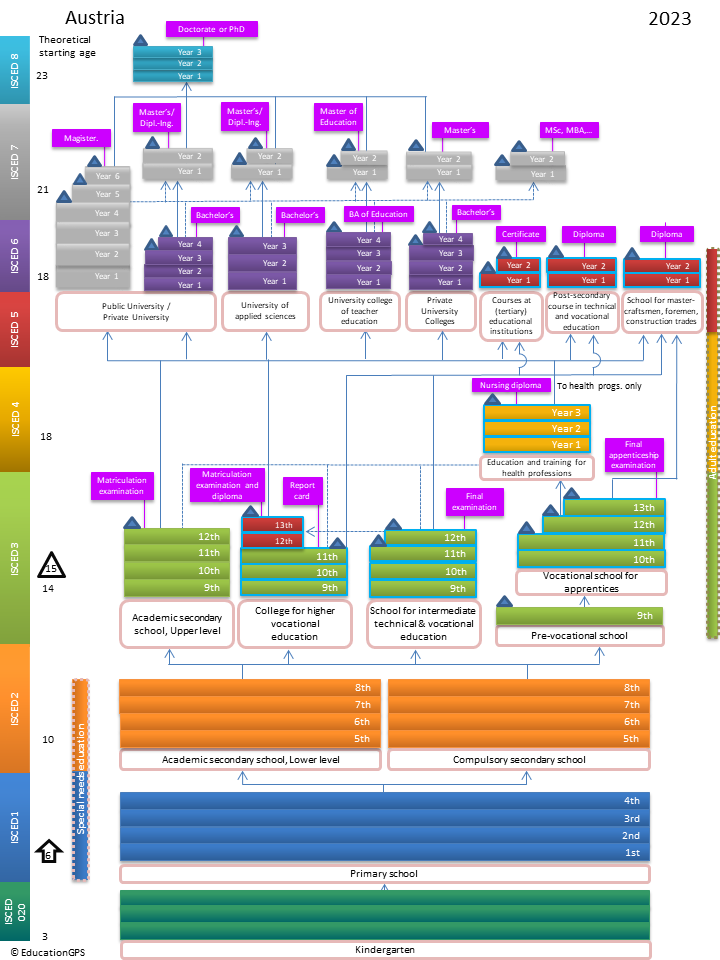
Click on the diagram to get a PDF version