Adult skills (Survey of Adult Skills, PIAAC, 2023)
In Ireland, adults aged 16-65 scored, on average, 263 points in literacy (above the OECD average), 260 points in numeracy (below the OECD average), and 249 points in adaptive problem solving (below the OECD average).
In literacy, 21% of adults (OECD average: 26%) scored at Level 1 or below, meaning they have low literacy proficiency. At Level 1, they can understand short texts and organised lists when information is clearly indicated, find specific information and identify relevant links. Those below Level 1 can at most understand short, simple sentences. At the other end of the spectrum, 9% of adults (OECD average: 12%) scored at Levels 4 or 5 in literacy and are high performers. These adults can comprehend and evaluate long, dense texts across several pages, grasp complex or hidden meanings, and use prior knowledge to understand texts and complete tasks.
In numeracy, 25% of adults (OECD average: 25%) scored at or below Level 1 proficiency. At Level 1, they can do basic maths with whole numbers or money, understand decimals, and find single pieces of information in tables or charts, but may struggle with tasks needing multiple steps (e.g. solving a proportion). Those below Level 1 can add and subtract small numbers. Adults at Levels 4 or 5 are top performers (10% in Ireland, 14% on average across OECD countries and economies) . They can calculate and understand rates and ratios, interpret complex graphs, and critically evaluate statistical claims.
In adaptive problem solving, 28% of adults (OECD average: 29%) scored at or below Level 1 proficiency. Adults at Level 1 can solve simple problems with few variables and little irrelevant information, which do not change as they make progress towards the solution. They struggle with multi-step problems, or those needing monitoring of multiple variables. Adults below Level 1 at most understand very simple problems, typically solved in one step. Some 3% of adults (OECD average: 5%) scored at Level 4. They have a deeper understanding of problems, and can adapt to unexpected changes, even if they require a major re-evaluation of the problem.
When considering all three domains jointly, 15% of adults in Ireland (OECD average: 18%) scored at the two lowest levels of these proficiency scales.
Select first some countries to compare, choose the charts you wish to display and customise them.
Highlights
Data table
Charts by topic
Policies
Publications
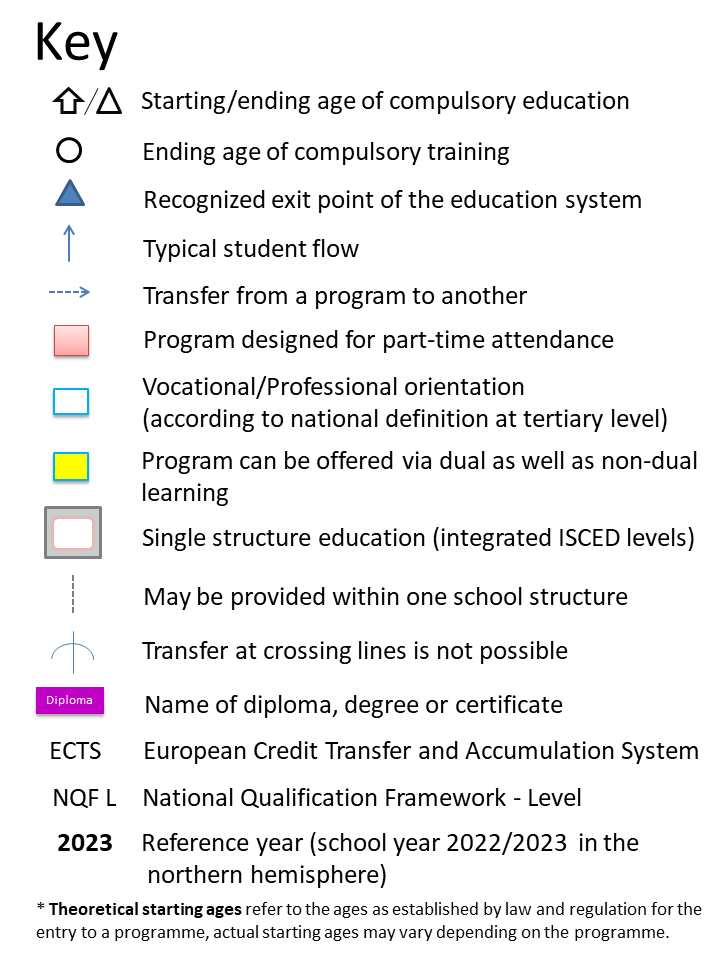
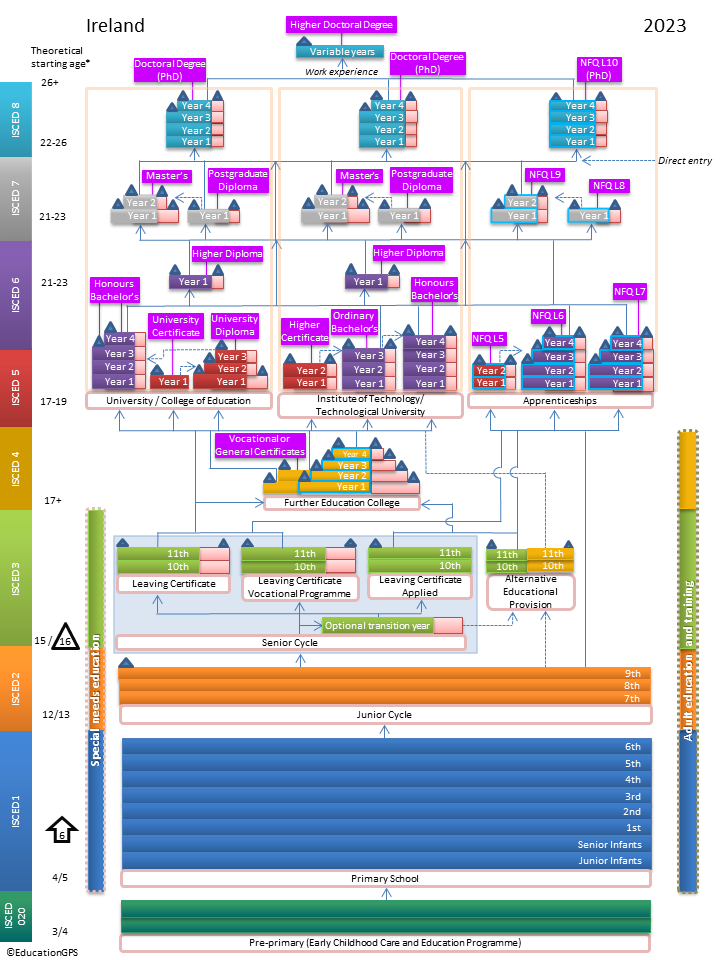
Diagram of education system
Compare with OECD countries
Australia
Austria
Belgium
Flemish Region (Belgium)
Belgium (French)
Belgium (excl. Flemish)
Canada
Alberta (Canada)
New Brunswick (Canada)
Quebec (Canada)
Canadian provinces
Chile
Colombia
Costa Rica
Czechia
Denmark
Estonia
Finland
France
Germany
Greece
Hungary
Iceland
Israel
Italy
Japan
Korea
Latvia
Lithuania
Luxembourg
Mexico
Netherlands
New Zealand
Norway
Poland
Portugal
Slovak Republic
Slovenia
Spain
Sweden
Switzerland
Türkiye
United Kingdom
England (UK)
Northern Ireland (UK)
Scotland (UK)
United States
OECD average
OECD total
And non-OECD countries
G20 average
TALIS average
TALIS avg. primary education
TALIS avg. upper secondary education
Albania
Algeria
Argentina
Armenia
Azerbaijan
Bahrain
Buenos Aires (Argentina)
Bosnia and Herzegovina
Brazil
Brunei Darussalam
Bulgaria
Cambodia
China
B-S-J-Z (China)
Hong Kong (China)
Macao (China)
Shanghai (China)
Chinese Taipei
Croatia
Dominican Republic
Ecuador
Egypt
El Salvador
Georgia
Guatemala
India
Indonesia
Jamaica
Jordan
Kazakhstan
Kenya
Kyrgyzstan
Kosovo
Kurdistan Region (Iraq)
Lebanon
North Macedonia
Malaysia
Malta
Mauritius
Moldova
Mongolia
Montenegro
Morocco
Palestinian Authority
Panama
Paraguay
Peru
Philippines
Qatar
Romania
Rwanda
Saudi Arabia
Serbia
Singapore
South Africa
Tajikistan
Dushanbe (Tajikistan)
Thailand
Trinidad and Tobago
Tunisia
United Arab Emirates
Abu Dhabi (UAE)
Ukraine
Uruguay
Uzbekistan
Viet Nam
Zambia
The following list displays indicators for which your selected country shows the highest and lowest values among countries.
The list can be sorted by level of education or by age group. All rankings are calculated including available data from OECD
and partner countries.
Find out more about the methodology here.
Show indicators for which your country ranks among the top or bottom:
Sort by:
16-65 years
The percentage of adults scoring high (at Level 4) in adaptive problem solving in the Survey of Adult Skills (PIAAC) is low compared to other participating countries.
(2.6 %, rank 22/31
, 2023) Download Indicator
The mean score in adaptive problem solving for adults with at least one parent who attained tertiary education is low compared to other countries participating in the Survey of Adult Skills (PIAAC).
(264 PIAAC Score, rank 22/31
, 2023) Download Indicator
The mean literacy score for foreign-born adults of foreign-born parents is high compared to other countries participating in the Survey of Adult Skills (PIAAC).
(254 PIAAC Score, rank 1/30
, 2023) Download Indicator
The mean numeracy score for foreign-born adults of foreign-born parents is high compared to other countries participating in the Survey of Adult Skills (PIAAC).
(258 PIAAC Score, rank 4/30
, 2023) Download Indicator
The mean score in adaptive problem solving for foreign-born adults of foreign-born parents is high compared to other countries participating in the Survey of Adult Skills (PIAAC).
(245 PIAAC Score, rank 2/30
, 2023) Download Indicator
The mean literacy score for adults whose parents had not attained upper secondary education is high compared to other countries participating in the Survey of Adult Skills (PIAAC).
(243 PIAAC Score, rank 10/31
, 2023) Download Indicator
The mean numeracy score with at least one parent with tertiary education is low compared to other countries participating in the Survey of Adult Skills (PIAAC).
(279 PIAAC Score, rank 22/31
, 2023) Download Indicator
25-34 years
The average actual salaries of 25-34 year-old lower-secondary teachers in Ireland are among the highest across countries with available data.
(63345 USD Equivalent, rank 8/27
, 2025) Download Indicator
Under 30 years
In upper secondary general education, the percentage of teachers under 30 in Ireland is one of the highest among OECD and partner countries with available data.
(12.5 %, rank 4/36
, 2024) Download Indicator
30-49 years
The percentage of primary to upper secondary teachers aged between 30 and 49 is especially high.
(66.4 %, rank 3/42
, 2024) Download Indicator
In Ireland, the percentage of upper secondary general education teachers aged between 30 and 49 is relatively high, compared to the other countries with available data.
(60.7 %, rank 8/36
, 2024) Download Indicator
The share of teachers aged between 30 and 49 in post secondary non-tertiary education is relatively small in Ireland, compared to other countries with available data.
(45.1 %, rank 17/22
, 2024) Download Indicator
50 years and over
The percentage of primary to upper secondary teachers older than 50 is especially low.
(20.8 %, rank 41/42
, 2024) Download Indicator
In upper secondary general education, the percentage of teachers aged 50 or more is particularly low in Ireland.
(26.8 %, rank 30/36
, 2024) Download Indicator
55-64 years
The salaries of 55-64 year-old general lower-secondary teachers relative to earnings for full-time, full-year similarly educated workers with tertiary education are low in Ireland.
(0.71 Ratio, rank 22/26
, 2025) Download Indicator
In Ireland, the average actual salaries of 55-64 year-old lower-secondary teachers is one of the highest among OECD and partner countries.
(98284 USD Equivalent, rank 3/27
, 2025) Download Indicator
The average actual salaries of 55-64 year-old lower secondary school heads is one of the highest in Ireland.
(146897 USD Equivalent, rank 6/24
, 2025) Download Indicator
25-64 years
In Ireland, average actual salaries for primary teachers aged 25-64 rank among the highest across OECD and partner countries with available data.
(79083 USD Equivalent, rank 5/34
, 2025) Download Indicator
In Ireland, average actual salaries for lower secondary teachers aged 25-64 rank among the highest across OECD and partner countries with available data.
(82831 USD Equivalent, rank 4/34
, 2025) Download Indicator
In Ireland, average actual salaries for upper secondary teachers aged 25-64 rank among the highest across OECD and partner countries with available data.
(82831 USD Equivalent, rank 8/34
, 2025) Download Indicator
The ratio of lower secondary female teachers' salaries to earnings of full-time, full-year women workers with tertiary education is one of the highest among OECD and partner countries with available data.
(1.14 Ratio, rank 5/26
, 2025) Download Indicator
In Ireland, the average actual salaries of 25-64 year-old primary school heads is one of the highest among OECD and partner countries.
(112274 USD Equivalent, rank 9/30
, 2025) Download Indicator
In Ireland, the average actual salaries of 25-64 year-old lower secondary school heads is one of the highest among OECD and partner countries.
(143755 USD Equivalent, rank 5/30
, 2025) Download Indicator
In Ireland, the average actual salaries of 25-64 year-old upper-secondary school heads is one of the highest among OECD and partner countries.
(143755 USD Equivalent, rank 8/30
, 2025) Download Indicator
All ages
In Ireland, compulsory instruction time for lower secondary students, in hours per year, is one of the shortest among OECD and partner countries with available data.
(465 Hours, rank 42/42
, 2024) Download Indicator
After 15 years of experience, a lower secondary teacher with minimum qualification can expect to have one of the highest salaries among OECD and partner countries with available data.
(77036 USD Equivalent, rank 10/42
, 2025) Download Indicator
The salary progression from the start to the top of the salary scale for a lower secondary school teacher is among the largest across OECD and partner countries with available data.
(1.95 Ratio, rank 7/43
, 2025) Download Indicator
Compared to 2015, the change in statutory salaries for primary education teachers with 15 years of experience and the most prevalent qualifications in Ireland was relatively small.
(86 Index, rank 33/33
, 2025) Download Indicator
Compared to 2015, the change in statutory salaries for lower secondary education teachers with 15 years of experience and the most prevalent qualifications in Ireland was relatively small.
(87 Index, rank 33/33
, 2025) Download Indicator
Compared to 2015, the change in statutory salaries for upper secondary education teachers with 15 years of experience and the most prevalent qualifications in Ireland was relatively small.
(87 Index, rank 33/33
, 2025) Download Indicator
It takes lower secondary teachers longer to progress through the salary scale in Ireland compared to other OECD and partner countries.
(35 Years, rank 9/42
, 2025) Download Indicator
The share of women among teaching staff in upper secondary education is one of the largest across OECD and partner countries with available data.
(67.9 %, rank 10/42
, 2024) Download Indicator
The share of women among teaching staff is one of the largest among OECD and partner countries with available data.
(77.3 %, rank 8/39
, 2024) Download Indicator
In lower secondary education, the salary ratio of teachers with maximum qualifications at the top of the salary scale to those with minimum training and starting salaries is comparatively high.
(1.95 Ratio, rank 7/44
, 2025) Download Indicator
After 15 years of experience, a primary teacher with typical qualification can expect to have one of the highest salaries among OECD and partner countries with available data.
(74863 USD Equivalent, rank 9/42
, 2025) Download Indicator
In Ireland, the number of students per teacher in all private secondary education is one of the smallest among OECD and partner countries with available data.
(6.3 Ratio, rank 38/38
, 2024) Download Indicator
In Ireland, the number of students per teacher in public institutions at the tertiary level is one of the highest among countries with available data.
(19.4 Ratio, rank 5/38
, 2024) Download Indicator
Not in education
The percentage of adults scoring high (at Level 4) in adaptive problem solving in the Survey of Adult Skills (PIAAC) is low compared to other participating countries.
(2.6 %, rank 22/31
, 2023) Download Indicator
The mean score in adaptive problem solving for adults with at least one parent who attained tertiary education is low compared to other countries participating in the Survey of Adult Skills (PIAAC).
(264 PIAAC Score, rank 22/31
, 2023) Download Indicator
The mean literacy score for foreign-born adults of foreign-born parents is high compared to other countries participating in the Survey of Adult Skills (PIAAC).
(254 PIAAC Score, rank 1/30
, 2023) Download Indicator
The mean numeracy score for foreign-born adults of foreign-born parents is high compared to other countries participating in the Survey of Adult Skills (PIAAC).
(258 PIAAC Score, rank 4/30
, 2023) Download Indicator
The mean score in adaptive problem solving for foreign-born adults of foreign-born parents is high compared to other countries participating in the Survey of Adult Skills (PIAAC).
(245 PIAAC Score, rank 2/30
, 2023) Download Indicator
The mean literacy score for adults whose parents had not attained upper secondary education is high compared to other countries participating in the Survey of Adult Skills (PIAAC).
(243 PIAAC Score, rank 10/31
, 2023) Download Indicator
The mean numeracy score with at least one parent with tertiary education is low compared to other countries participating in the Survey of Adult Skills (PIAAC).
(279 PIAAC Score, rank 22/31
, 2023) Download Indicator
Primary
Compared to 2015, the change in statutory salaries for primary education teachers with 15 years of experience and the most prevalent qualifications in Ireland was relatively small.
(86 Index, rank 33/33
, 2025) Download Indicator
In Ireland, average actual salaries for primary teachers aged 25-64 rank among the highest across OECD and partner countries with available data.
(79083 USD Equivalent, rank 5/34
, 2025) Download Indicator
After 15 years of experience, a primary teacher with typical qualification can expect to have one of the highest salaries among OECD and partner countries with available data.
(74863 USD Equivalent, rank 9/42
, 2025) Download Indicator
In Ireland, the average actual salaries of 25-64 year-old primary school heads is one of the highest among OECD and partner countries.
(112274 USD Equivalent, rank 9/30
, 2025) Download Indicator
Primary and secondary
The percentage of primary to upper secondary teachers aged between 30 and 49 is especially high.
(66.4 %, rank 3/42
, 2024) Download Indicator
The percentage of primary to upper secondary teachers older than 50 is especially low.
(20.8 %, rank 41/42
, 2024) Download Indicator
Lower secondary, general
In Ireland, compulsory instruction time for lower secondary students, in hours per year, is one of the shortest among OECD and partner countries with available data.
(465 Hours, rank 42/42
, 2024) Download Indicator
After 15 years of experience, a lower secondary teacher with minimum qualification can expect to have one of the highest salaries among OECD and partner countries with available data.
(77036 USD Equivalent, rank 10/42
, 2025) Download Indicator
The salary progression from the start to the top of the salary scale for a lower secondary school teacher is among the largest across OECD and partner countries with available data.
(1.95 Ratio, rank 7/43
, 2025) Download Indicator
Compared to 2015, the change in statutory salaries for lower secondary education teachers with 15 years of experience and the most prevalent qualifications in Ireland was relatively small.
(87 Index, rank 33/33
, 2025) Download Indicator
It takes lower secondary teachers longer to progress through the salary scale in Ireland compared to other OECD and partner countries.
(35 Years, rank 9/42
, 2025) Download Indicator
In Ireland, average actual salaries for lower secondary teachers aged 25-64 rank among the highest across OECD and partner countries with available data.
(82831 USD Equivalent, rank 4/34
, 2025) Download Indicator
In lower secondary education, the salary ratio of teachers with maximum qualifications at the top of the salary scale to those with minimum training and starting salaries is comparatively high.
(1.95 Ratio, rank 7/44
, 2025) Download Indicator
The ratio of lower secondary female teachers' salaries to earnings of full-time, full-year women workers with tertiary education is one of the highest among OECD and partner countries with available data.
(1.14 Ratio, rank 5/26
, 2025) Download Indicator
The salaries of 55-64 year-old general lower-secondary teachers relative to earnings for full-time, full-year similarly educated workers with tertiary education are low in Ireland.
(0.71 Ratio, rank 22/26
, 2025) Download Indicator
The average actual salaries of 25-34 year-old lower-secondary teachers in Ireland are among the highest across countries with available data.
(63345 USD Equivalent, rank 8/27
, 2025) Download Indicator
In Ireland, the average actual salaries of 55-64 year-old lower-secondary teachers is one of the highest among OECD and partner countries.
(98284 USD Equivalent, rank 3/27
, 2025) Download Indicator
In Ireland, the average actual salaries of 25-64 year-old lower secondary school heads is one of the highest among OECD and partner countries.
(143755 USD Equivalent, rank 5/30
, 2025) Download Indicator
The average actual salaries of 55-64 year-old lower secondary school heads is one of the highest in Ireland.
(146897 USD Equivalent, rank 6/24
, 2025) Download Indicator
Upper secondary
The share of women among teaching staff in upper secondary education is one of the largest across OECD and partner countries with available data.
(67.9 %, rank 10/42
, 2024) Download Indicator
Upper secondary, general
Compared to 2015, the change in statutory salaries for upper secondary education teachers with 15 years of experience and the most prevalent qualifications in Ireland was relatively small.
(87 Index, rank 33/33
, 2025) Download Indicator
In Ireland, average actual salaries for upper secondary teachers aged 25-64 rank among the highest across OECD and partner countries with available data.
(82831 USD Equivalent, rank 8/34
, 2025) Download Indicator
In Ireland, the average actual salaries of 25-64 year-old upper-secondary school heads is one of the highest among OECD and partner countries.
(143755 USD Equivalent, rank 8/30
, 2025) Download Indicator
In upper secondary general education, the percentage of teachers aged 50 or more is particularly low in Ireland.
(26.8 %, rank 30/36
, 2024) Download Indicator
In upper secondary general education, the percentage of teachers under 30 in Ireland is one of the highest among OECD and partner countries with available data.
(12.5 %, rank 4/36
, 2024) Download Indicator
In Ireland, the percentage of upper secondary general education teachers aged between 30 and 49 is relatively high, compared to the other countries with available data.
(60.7 %, rank 8/36
, 2024) Download Indicator
Secondary
In Ireland, the number of students per teacher in all private secondary education is one of the smallest among OECD and partner countries with available data.
(6.3 Ratio, rank 38/38
, 2024) Download Indicator
Post-secondary non-tertiary
The share of teachers aged between 30 and 49 in post secondary non-tertiary education is relatively small in Ireland, compared to other countries with available data.
(45.1 %, rank 17/22
, 2024) Download Indicator
Total tertiary
In Ireland, the number of students per teacher in public institutions at the tertiary level is one of the highest among countries with available data.
(19.4 Ratio, rank 5/38
, 2024) Download Indicator
All levels of education
The share of women among teaching staff is one of the largest among OECD and partner countries with available data.
(77.3 %, rank 8/39
, 2024) Download Indicator
Adaptive problem solving
The percentage of adults scoring high (at Level 4) in adaptive problem solving in the Survey of Adult Skills (PIAAC) is low compared to other participating countries.
(2.6 %, rank 22/31
, 2023) Download Indicator
Skills by immigrant and language background
The mean literacy score for foreign-born adults of foreign-born parents is high compared to other countries participating in the Survey of Adult Skills (PIAAC).
(254 PIAAC Score, rank 1/30
, 2023) Download Indicator
The mean numeracy score for foreign-born adults of foreign-born parents is high compared to other countries participating in the Survey of Adult Skills (PIAAC).
(258 PIAAC Score, rank 4/30
, 2023) Download Indicator
The mean score in adaptive problem solving for foreign-born adults of foreign-born parents is high compared to other countries participating in the Survey of Adult Skills (PIAAC).
(245 PIAAC Score, rank 2/30
, 2023) Download Indicator
Skills by parents' educational attainment
The mean score in adaptive problem solving for adults with at least one parent who attained tertiary education is low compared to other countries participating in the Survey of Adult Skills (PIAAC).
(264 PIAAC Score, rank 22/31
, 2023) Download Indicator
The mean literacy score for adults whose parents had not attained upper secondary education is high compared to other countries participating in the Survey of Adult Skills (PIAAC).
(243 PIAAC Score, rank 10/31
, 2023) Download Indicator
The mean numeracy score with at least one parent with tertiary education is low compared to other countries participating in the Survey of Adult Skills (PIAAC).
(279 PIAAC Score, rank 22/31
, 2023) Download Indicator
Who the teachers are
The share of women among teaching staff in upper secondary education is one of the largest across OECD and partner countries with available data.
(67.9 %, rank 10/42
, 2024) Download Indicator
The share of women among teaching staff is one of the largest among OECD and partner countries with available data.
(77.3 %, rank 8/39
, 2024) Download Indicator
The percentage of primary to upper secondary teachers aged between 30 and 49 is especially high.
(66.4 %, rank 3/42
, 2024) Download Indicator
The percentage of primary to upper secondary teachers older than 50 is especially low.
(20.8 %, rank 41/42
, 2024) Download Indicator
In upper secondary general education, the percentage of teachers aged 50 or more is particularly low in Ireland.
(26.8 %, rank 30/36
, 2024) Download Indicator
In upper secondary general education, the percentage of teachers under 30 in Ireland is one of the highest among OECD and partner countries with available data.
(12.5 %, rank 4/36
, 2024) Download Indicator
In Ireland, the percentage of upper secondary general education teachers aged between 30 and 49 is relatively high, compared to the other countries with available data.
(60.7 %, rank 8/36
, 2024) Download Indicator
The share of teachers aged between 30 and 49 in post secondary non-tertiary education is relatively small in Ireland, compared to other countries with available data.
(45.1 %, rank 17/22
, 2024) Download Indicator
Teachers' salaries
After 15 years of experience, a lower secondary teacher with minimum qualification can expect to have one of the highest salaries among OECD and partner countries with available data.
(77036 USD Equivalent, rank 10/42
, 2025) Download Indicator
Compared to 2015, the change in statutory salaries for primary education teachers with 15 years of experience and the most prevalent qualifications in Ireland was relatively small.
(86 Index, rank 33/33
, 2025) Download Indicator
Compared to 2015, the change in statutory salaries for lower secondary education teachers with 15 years of experience and the most prevalent qualifications in Ireland was relatively small.
(87 Index, rank 33/33
, 2025) Download Indicator
Compared to 2015, the change in statutory salaries for upper secondary education teachers with 15 years of experience and the most prevalent qualifications in Ireland was relatively small.
(87 Index, rank 33/33
, 2025) Download Indicator
In Ireland, average actual salaries for primary teachers aged 25-64 rank among the highest across OECD and partner countries with available data.
(79083 USD Equivalent, rank 5/34
, 2025) Download Indicator
In Ireland, average actual salaries for lower secondary teachers aged 25-64 rank among the highest across OECD and partner countries with available data.
(82831 USD Equivalent, rank 4/34
, 2025) Download Indicator
In Ireland, average actual salaries for upper secondary teachers aged 25-64 rank among the highest across OECD and partner countries with available data.
(82831 USD Equivalent, rank 8/34
, 2025) Download Indicator
After 15 years of experience, a primary teacher with typical qualification can expect to have one of the highest salaries among OECD and partner countries with available data.
(74863 USD Equivalent, rank 9/42
, 2025) Download Indicator
The ratio of lower secondary female teachers' salaries to earnings of full-time, full-year women workers with tertiary education is one of the highest among OECD and partner countries with available data.
(1.14 Ratio, rank 5/26
, 2025) Download Indicator
The salaries of 55-64 year-old general lower-secondary teachers relative to earnings for full-time, full-year similarly educated workers with tertiary education are low in Ireland.
(0.71 Ratio, rank 22/26
, 2025) Download Indicator
The average actual salaries of 25-34 year-old lower-secondary teachers in Ireland are among the highest across countries with available data.
(63345 USD Equivalent, rank 8/27
, 2025) Download Indicator
In Ireland, the average actual salaries of 55-64 year-old lower-secondary teachers is one of the highest among OECD and partner countries.
(98284 USD Equivalent, rank 3/27
, 2025) Download Indicator
Teachers' salaries progression
The salary progression from the start to the top of the salary scale for a lower secondary school teacher is among the largest across OECD and partner countries with available data.
(1.95 Ratio, rank 7/43
, 2025) Download Indicator
It takes lower secondary teachers longer to progress through the salary scale in Ireland compared to other OECD and partner countries.
(35 Years, rank 9/42
, 2025) Download Indicator
In lower secondary education, the salary ratio of teachers with maximum qualifications at the top of the salary scale to those with minimum training and starting salaries is comparatively high.
(1.95 Ratio, rank 7/44
, 2025) Download Indicator
Principals' salaries
In Ireland, the average actual salaries of 25-64 year-old primary school heads is one of the highest among OECD and partner countries.
(112274 USD Equivalent, rank 9/30
, 2025) Download Indicator
In Ireland, the average actual salaries of 25-64 year-old lower secondary school heads is one of the highest among OECD and partner countries.
(143755 USD Equivalent, rank 5/30
, 2025) Download Indicator
In Ireland, the average actual salaries of 25-64 year-old upper-secondary school heads is one of the highest among OECD and partner countries.
(143755 USD Equivalent, rank 8/30
, 2025) Download Indicator
The average actual salaries of 55-64 year-old lower secondary school heads is one of the highest in Ireland.
(146897 USD Equivalent, rank 6/24
, 2025) Download Indicator
Ratio of student to teaching staff
In Ireland, the number of students per teacher in all private secondary education is one of the smallest among OECD and partner countries with available data.
(6.3 Ratio, rank 38/38
, 2024) Download Indicator
In Ireland, the number of students per teacher in public institutions at the tertiary level is one of the highest among countries with available data.
(19.4 Ratio, rank 5/38
, 2024) Download Indicator
Organisation of the education system
In Ireland, compulsory instruction time for lower secondary students, in hours per year, is one of the shortest among OECD and partner countries with available data.
(465 Hours, rank 42/42
, 2024) Download Indicator
The data table will display up to six selected countries.
General findings
Literacy
Numeracy
Problem solving
In the 2023 Survey of Adult Skills, literacy is defined as "accessing, understanding, evaluating, and reflecting on written texts in order to achieve one's goals, to develop one's knowledge and potential, and to participate in society" (Rouet et al., 2021). Proficiency in literacy is crucial for adults across their personal, social and professional spheres, given the prevalence of written communication in various aspects of life. Throughout the day, adults engage in a diverse range of reading activities, spanning from delving into extensive pieces of continuous text to swiftly scanning pages for pertinent information. Examples include reading emails, leaflets, timetables and instruction manuals.
Click the arrow sign next to the title:
to display other variables
Click the arrow sign next to the title:
to display other variables
Click the arrow sign next to the title:
to display other variables
In the 2023 Survey of Adult Skills, numeracy encompasses "accessing, using, and reasoning critically with mathematical content, information and ideas represented in multiple ways in order to engage in and manage the mathematical demands of a range of situations in adult life" (Tout et al., 2021). The skills and knowledge needed for work and civic participation, and in more personal spheres of life, have changed. Individuals are presented with ever-increasing amounts of information of a quantitative or mathematical nature through online or technology-based resources, which have to be located, selected or filtered, interpreted, and at times questioned and doubted, and analysed for their relevance to the responses needed.
Click the arrow sign next to the title:
to display other variables
Click the arrow sign next to the title:
to display other variables
Click the arrow sign next to the title:
to display other variables
The first cycle of the Survey of Adult Skills measured problem solving in technology-rich environments. This is defined as the ability to use digital technology, communication tools and networks to acquire and evaluate information, communicate with others and perform practical tasks. The survey assessed adults' ability to solve problems by establishing appropriate goals and plans, and accessing and using information through computers and computer networks.
In the 2023 Survey of Adult Skills, problem solving in technology-rich environments was replaced by adaptive problem solving (APS). This involves "the capacity to achieve one’s goals in a dynamic situation in which a method for solution is not immediately available. It requires engaging in cognitive and metacognitive processes to define the problem, search for information, and apply a solution in a variety of information environments and contexts" (Greiff et al., 2021).
APS has three important features. First, it emphasises individuals’ capacity to flexibly and dynamically adapt their problem-solving strategies to a dynamically changing environment. Second, it tests their ability to identify and select among a range of available physical, social and digital resources. Third, individuals need to monitor and reflect on their progress in solving problems, through metacognitive processes.
Click on the coverpage to see the full OECD iLibrary version
Note: These values should be interpreted with care since they are influenced by countries' specific contexts and trade-offs. In education, there is often no simple
most- or least-efficient model. For instance, the share of private expenditure in education must be read against other measures designed to mitigate inequities,
such as loans and grants; longer learning time is an opportunity to convey more and better content to students, but may hinder investments in other important
areas. If you want further information on the nature of different variables, please take the time to read the analysis and contextual information, available at the website
for each publication.
All rankings for individual variables are compiled on the basis of OECD and G20 countries for which data are available. The OECD average includes only OECD countries which are listed here: https://www.oecd.org/en/about/members-partners.html
Reference years displayed in the Education GPS correspond to the most common year of reference among countries for which data is available on each variable. Data for the latest available year is preferred and some
countries may have provided data refering to a more recent or late year.
However, OECD averages from Education at a Glance coming from the OECD database are the averages for the indicator reference year appearing in the Education GPS and may differ from averages in the book where averages can include data from multiple reference years, based on countries' data availability.
To know more about possible exceptions on data please click on the "Download Indicator" link on each variable. When a year of reference corresponds to a school year encompassing two years, the reference reads as follows: 2026 for school year 2025/2026 in the Northern Hemisphere.
*TALIS averages are based on all countries participating in the TALIS survey, including partner countries and economies.
This explains the difference between the OECD average and the TALIS averages.
Data from the TALIS survey and Education at a Glance (EAG) may differ. See Annex E of the TALIS technical report and
Sources Methodologies and Technical Notes
of EAG 2025 for more details about the data collections.
For additional notes, please refer to annexes in the list of links below the introductory country profile text.





 to display other variables